¿Listo para aprender?
Seleccione un idioma para empezar
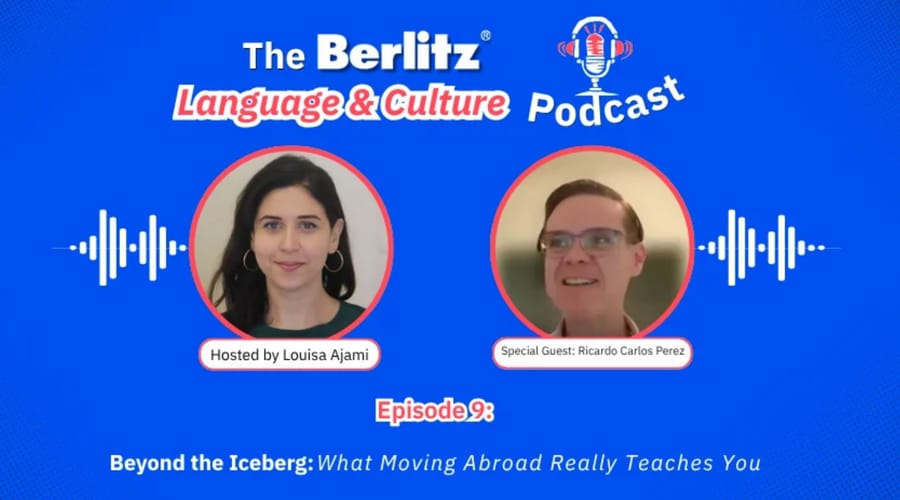
Beyond the Iceberg: What Moving Abroad Really Teaches You [Podcast]
Author:
Berlitz
In Episode 9 of the Berlitz Language & Culture Podcast, host Louisa Ajami sits down with Ricardo Carlos Perez, an intercultural expert whom we've had the pleasure of working with here at Berlitz for many years.
Ricardo has extensive international experience, having worked in both the private and public sectors in Mexico, Canada, and the United States. Ricardo is a global human resources leader and is certified in Berlitz cultural orientation approach, which he has used in his organizations to improve the performance and effectiveness of multicultural teams around the world. He's also got experience supporting expats and their families relocating to other countries and helping them navigate daily life, workplace practices, and new cultural landscapes.
Ricardo Carlos Perez INTRO (16:54-17:22): And I think having that skill set to work with others across differences, as you mentioned, is crucial more than now, more than ever, and teaching others to do the same, which is the fourth and most advanced deal, as you know, that we have at Berlin, which is cultural mentoring, you know, using what you have learned, using what you have tested and tried, and share that with others so they themselves can Be more competent in their own growth and development.
Louisa Ajami: Hello and welcome to the Berlitz language and culture podcast today we're excited to have with us. Ricardo Carlos Perez, an international cultural expert. Three seconds, I'm just going to start all the way over again. I said international instead of intercultural. I guess you are international, but New start (:30) Hello and welcome to the Berlitz language and culture podcast today. We're excited to have with us Ricardo Carlos Perez, an intercultural expert who we've had the pleasure of working with here at Berlitz for many years, Ricardo has an extensive international experience, having worked in both the private and public sectors in Mexico, Canada and the United States. Ricardo is a global human resources leader and is certified in Berlitz cultural orientation approach, which he has used in his organizations to improve the performances and effectiveness of multicultural teams around the world. He's also got experience supporting expats and their families relocating to other countries and helping them navigate daily life, workplace practices and new cultural landscapes. Originally from Guadalajara, Mexico, Ricardo joins us today from his current location in the city of Austin, Texas. Welcome Ricardo to the podcast.
Ricardo Carlos Perez: Hello Luisa. Hello everyone. Thank you so much for the invitation. It is my pleasure to participate in the Berlitz language and cultural podcast with you all.
Louisa Ajami: Thanks for joining us. So Ricardo, why don't you tell us a little bit about your international experiences?
Ricardo Carlos Perez: Yes, as you said, Louisa, I have had the privilege to work for a variety of organizations, large and small, in Mexico, Canada, and now in the United States, where I had the opportunity to interact with individuals from all over the world. I've always been fascinated by languages and cultures from a very young age, at 18 years old, Luis, I had the opportunity to also study abroad in Germany for a year, which truly transformed my life and the way that I see the world. And I am sure people listening might have their own experience where their interest in culture also emerge Wonderful.
Louisa Ajami: So here at Berlitz, we include the four key cultural skills in our cultural training, and the first of these skills is due diligence, which is preparing for your new cultural situation by learning as much as you can ahead of time to preempt and minimize any negative surprises. So was this part of your preparations ahead of your own expat experiences, starting in college,
Ricardo Carlos Perez: I have to say Louisa that more so for my most recent relocation, the first time I relocated, which was from Mexico to Canada, I honestly didn't do a very good job. I was so excited that I didn't really think much about the potential challenges that I was going to encounter. I didn't go deep in the cultural iceberg, which, as you know, is a concept that we typically cover during our training. And for those of you that might be new to that, just imagine an iceberg floating in the ocean where about only 20% of the mass is visible and the remaining 80% is not visible. Well, Louisa, that happened to me. I was somewhat familiar with the tip of the Canadian iceberg. You know, obviously a language, the food, some social cues, but not so with the more in depth values and beliefs. The Canada is a more egalitarian society, which is it meaning that it's just less hierarchical, and this is also reflected in their organizational culture. Before moving to Canada, I worked for Berlitz, and I work also for Berlitz in Mexico, and Mexico is typically a more hierarchical society, or at least it was, you know, 20 plus years ago. So an example that I want to share with you was working for, you know, in for the same company in both countries, and I remember doing business plan with my supervisor in Mexico, where I was used to having goals cascaded down to me, and then we'll have a conversation about how we would achieve them together in Canada, though, again, same company, but my manager had a different approach. I remember having a conversation when he asked me about my ideas for my plan, for my yearly plan, and I remember just feeling a little bit confused because I have never done that before, and I assume that because we were working for the same company, you know, it would be a very similar conversation. And he was also taken aback. So I'm sure that we were probably both very frustrated thinking that, you know, we were not very competent in our roles. So again, you know, the. Talent Canada is to be more collective and versus the top down approach, I guess that I was used to in Mexico, luckily, though we both worked for Berlin, so we use our skill set to analyze what was happening and course correct, which ended up in us working together for many years now, I have to tell you that that was a big lesson. So when I'm I didn't take much for granted, even though it started there,
Louisa Ajami: yeah, start there, yeah.
Ricardo Carlos Perez: So I was much more prepared when I moved to the US. I didn't take much for granted that time, even though it was also actually for the same company, different job, not for Berlin this time. So I really took my time to study more about the country, the business dynamics in the US, but also particularly in the region within the US where I work, which was us out, and also looking after some operations in the Midwest. I also spoke to a lot of people Luisa, I call those my cultural informants. So I had both formal and informal sources that were part of my due diligence exercise. So I definitely would recommend that cultural due diligence. Is that a skill that is going to give you that foundation, that understanding of areas of strength as well as areas that you need to develop. And I'm sure it is a, you know, a very good recommendation for anybody not only relocating somewhere, but working with colleagues from different cultures.
Louisa Ajami: You made a couple of really great points there. And the first one I wanted to note was that you talked about how it was the same company. So it's very easy to assume that even if we're going to a different geographic location, within the same companies, under the purview of the same company, that it will have the same culture. And you also noted that even within companies, there's different types of cultures depending on the team you're on or the function. And then also within the same nation, you noted how here in the US, there's quite a few cultural divides between northerners and southerners, east coasters and west coasters, and I think that's true of probably most countries in the world. So there's so many layers that you really have to account for when you're doing your due diligence.
Ricardo Carlos Perez: There are so many layers, Luis, I couldn't agree with you more, and it is all about having the right mindset to be open to those new experiences. I believe that that was the differentiator for me when, again, I didn't take much for granted and I was able to look at my formal sources, having conversations, test my assumptions and keep on learning. So I couldn't agree with you more.
Louisa Ajami: yeah, and it's a constant process, isn't it? Due diligence is just the first step.
Ricardo Carlos Perez: It is nice, indeed. Yeah.
Louisa Ajami: Now, after you arrived, what kind of challenges did you have at the beginnings of your different expat experiences?
Ricardo Carlos Perez: Yes, well, I am happy to share, I guess, both some personal as well as professional challenges. Well, let's start with the professional challenges, as I mentioned. You know, even though it was the same company. It was literally like working for a brand new organization, because the leadership style was different, the commission is communication style was a little bit different, the clientele and even the business, the business environment. In my previous role, I used to work for head office. In my new role, I was working in an environment where we were acquiring different companies. And as you know, every company has their own way of doing things, their own cultural elements to it. So it was really a interesting and fascinating process to navigate find commonalities, drive strengths and understanding from those and working on the differences to make sure that everybody was getting aligned on the personal front. Louisa, gosh, where do I start? You know, from the education system to the healthcare system to the banking system to not having a credit score to buy almost anything. You know, it was definitely a challenge, but also an opportunity to learn how to do things differently in new ways. And I believe that that is what we did. You know, over time, you get used to how the system works. You know anything from you know how to find a doctor, how to open a bank account, and all of those elements that typically you wouldn't think about until you move to a different location.
Louisa Ajami: Absolutely, these are things that they don't always train you in ahead of time, and the more due diligence that you can do at the beginning or even before you leave, the easier it comes to navigate those obstacles, those challenges, so you can sort of hit the ground. Running, running once you actually get there.
Ricardo Carlos Perez: Yeah, Luis, and that just reminds me, you know, what we do in some of our training programs in terms of the culture change curve, you know, and that process that we all go through when we are encountering a new experience, either again, working for any organization, relocation, even moving, you know, from one city to the other, and the skill set that is needed to navigate that change, going all the way from the honeymoon period, where we're all excited to having to face the new reality, where you might feel some stress and anxiety, all the way to the skill set that is needed to readjust and come stronger and better and more resilient on the other side,
Louisa Ajami: absolutely now, you've worked with lots of other expats. You've helped a lot of people relocate and acclimate to their new geographical and cultural surroundings. What are some areas of stress or areas of challenges that you found when working with extra other expats on similar experiences to yours?
Ricardo Carlos Perez: Well, I have to start by saying Luisa that the change that I have seen over the years is incredible. From when I first started doing intercultural work, the information available is much more sophisticated. And I would say that working in multicultural settings is now more common than ever, unless you, of course, work, probably for a small business in a very specific location. So I would say that there is really not much excuse for not doing cultural diligence these days. But the challenge now lies in how to use that information so you can go into the other elements of a style switching and cultural dialog. So again, for those listening style switching is when you find yourself in a situation where you are interacting with someone who is very set in their own ways, think management style or a specific communication style. If their style is set and opposite to yours, then you have to switch to match their style a little bit better for more effective communication. And cultural dialog is when both parties noted different styles and preferences and are actively working together to adapt. So again, that is what happened to me my supervisor at Berlitz, when we both realized what was happening, we had to do a little bit of cultural dialog and came to an understanding so those realities Luisa still happen. I believe for any type of relocation, either short term or permanent, it is about self awareness. You know, I believe that that is the number one and the first step that everybody doing intercultural work needs to start with. And we have a very famous quote right from Lao Tzu. It says, He who knows others is wise, He who knows himself is enlightened. So a lot of the work that we do is working with individuals, for them to understand their own styles and preferences, where they come from. You know, why are some easier to change than others, and why? What do we do in those situations where we might need to go into a style switch or cultural dialog? So I believe that those challenges remain because they are so personal, and it is about having the conversations from space of positivity and say, Hey, you are going to be more effective, both professionally and personally, when you are able to understand those dynamics for yourself and how to best apply them when interacting with others.
Louisa Ajami: Thanks for bringing up that Lao Tzu quote, and we've seen that across ancient writings and more modern writings too, which really goes to show how much of a timeless saying it is, know thyself, know yourself, and then you can know others, but the first step is learning about your own preferences, the reasons you do things, the way you react to things, so that you can use that as an open door to go through on your way to becoming more culturally competent, more able to adapt and thrive within systems that are different from your own, and you can become able to work with people who have different expectations, different approaches to your own approach, regardless of whether you're in the same country or you're an expat, moving into a new organization, moving on to a new team, etc.
Ricardo Carlos Perez: What I often also like Luisa, is the surprises that come with that analysis. Sometimes, you know, we do have the the COI assessment, the cultural orientations, approach assessment. And I remember taking that assessment and taking a look at the results and thinking, is that really me, you know. And then asking other friends and colleagues who are close to me and saying, Yep, that's who you are. So sometimes we might even have some blind spots as we do that, a bit of self awareness, self analysis,
Louisa Ajami: absolutely, I think blind spots are very common, and it's important to go into this, as you said earlier. Of an open mind with curiosity. Rather than looking at it as a measure of your success or your abilities, it's a measure of taking the assessment. The COI assessment is a measure of your preferences as they are now, which is a map of the things that have influenced you, the orientations you have. And that's an important place to start on the journey towards cultural competence, being able to be an inclusive leader, being able to manage different teams, being able to move across this world that we live in in a knowledgeable and also curious way. Now cultural training. Cultural training can be very valuable, even for people who work in their home country and for those in offices where everyone even has a similar national background. What are some of the skills you've used with expats that can also be used for those who are living and working in their home country?
Ricardo Carlos Perez: The very simple answer, Louisa, is all of them because they are so applicable. As I said, you know, when I when I moved to the US, I didn't know the major cultural differences that exist within the country, starting from geographical areas. You know the difference between the Northeast, the Midwest, the southeast, etc, and even also within the state of Texas, which is where I currently live, there are differences depending on the city where you live, between Dallas, Houston, Austin, San Antonio, even differences whether you live in an urban versus rural setting. So cross cultural skills are truly transferable and applicable to many settings and situations. The other reality is how rapidly the world is changing these days, while the geopolitical landscape is being transformed, so are the way we do business. And I think having that skill set to work with others across differences, as you mentioned, is crucial more than now, more than ever, and teaching others to do the same, which is the fourth and most advanced deal, as you know, that we have at Berlin, which is cultural mentoring, you know, using what you have learned, using what you have tested and tried, and share that with others so they themselves can Be more competent in their own growth and development.
Louisa Ajami: Yeah, mentoring is really where it comes full circle, and I'm assuming that you have been mentored in the past. And are you also doing mentoring at your position right now, at this part of your career?
Ricardo Carlos Perez: Yes, you know, I am a huge proponent on mentoring relationships, both formal and informal, so I have had the privilege of running mentoring programs for different organizations where I do volunteer, and also within the different organizations that I have worked with, and that learning never stops. What I like the most, though, Luis, I'm going to be honest with you, is besides all of the skills and development that takes place, it is the connections that you make with either your mentor or mentee. You know, for me, those initial connections have become, you know, long time friendships that continue until today. And I know that we have, I have a group of people that I can call upon that know me, they understand who I am, and then help me navigate different elements of my professional life. So I'm a huge proponent of it, and something that I'm, you know, a big advocate and passionate about,
Louisa Ajami: mentoring really is an invaluable program that lots of organizations can do. It doesn't take a lot of time or money, but what it does, as you said, is it creates these connections, especially among people who might never have gotten a chance to meet each other within the organization. Perhaps they're at different departments, perhaps they're at different hierarchical levels. So when we forge those connections, what we're doing is suspending status hierarchies, suspending age hierarchies, and creating lines of connectivity that can really bring the people together themselves, but also bring departments and teams together, and that helps organizations reinforce their culture, which is extremely valuable, especially because mentoring is a pretty cost effective way of reinforcing the company culture.
Ricardo Carlos Perez: I love that, to Louisa, and that is what keep the cultural life, you know, and when we keep transforming it, we keep shaping it. As you said, it's an ongoing process.
Louisa Ajami: Well, thank you so much for the insights you've brought us for this wonderful conversation, we were honored to have you, Ricardo, and it's been so great to hear everything you have to say and for you to share the knowledge you've acquired throughout your professional experiences across countries, across organizations, and to our listeners, thank you so much for tuning into the Berlitz language and culture podcast. Tune in for more.