
Remembrance Day and Bilingualism: Why Federal and Veterans Affairs Roles Value Language Skills
Author:
Berlitz
Remembrance is bilingual in Canada, and so is serving those we remember.
Every November 11, Canadians pause to honour those who served and died in war. Whether you're new to Canada or learning French, knowing the words of the day in both official languages helps you take part with respect.
This guide covers the key vocabulary in English and French. It also explains why bilingual skills matter so much in federal roles that serve veterans and their families.
Published November 9, 2026 · By Berlitz Canada · 6 min read
Table of Contents
- What Remembrance Day Commemorates
- Remembrance Day Vocabulary in English and French
- Why Language Matters When Serving Veterans
- Federal Roles Where Bilingualism Counts
- Building the Skills for Sensitive Conversations
- Frequently Asked Questions
What Remembrance Day Commemorates
Remembrance Day takes place every year on November 11. At 11 a.m., ceremonies across the country pause for a moment of silence, marking the hour the First World War armistice took effect in 1918.
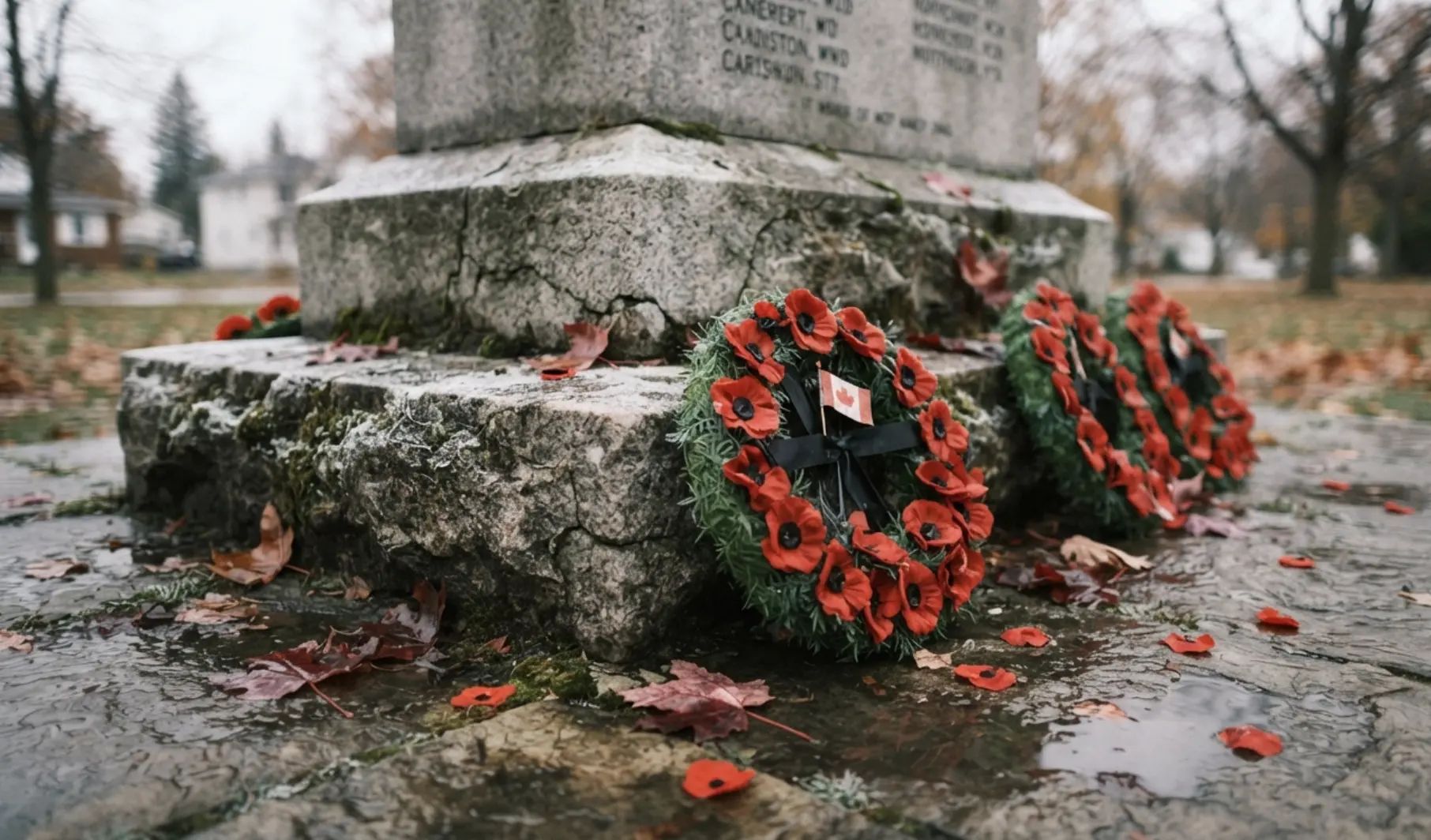
The red poppy is the day's best-known symbol. According to Veterans Affairs Canada, Canadian doctor John McCrae, from Guelph, Ontario, wrote the poem In Flanders Fields in 1915 near Ypres, Belgium. The poem helped make the poppy the flower of remembrance in Canada and other Commonwealth countries.
You'll see poppies on lapels from the last Friday of October until November 11, when the poppy campaign ends.
Remembrance Day Vocabulary in English and French
You'll hear these words at ceremonies, in schools and in the media. Here are the French equivalents used in Canada.
| English | Français |
|---|---|
| Remembrance Day | le jour du Souvenir |
| poppy | le coquelicot |
| Lest we forget | N'oublions jamais |
| veteran | le vétéran / l'ancien combattant |
| cenotaph | le cénotaphe |
| war memorial | le monument commémoratif |
| wreath | la couronne |
| moment of silence | le moment de silence |
| the Last Post | la Dernière sonnerie |
In French, Souvenir takes a capital S in jour du Souvenir. You'll also see both vétéran and ancien combattant in Canadian French, and Veterans Affairs Canada is called Anciens Combattants Canada.
Why Language Matters When Serving Veterans
Veterans and their families include both English and French speakers. Many of them contact federal services about health, benefits or the loss of a loved one. These are the conversations where being understood in your own language matters most.
The law reflects this. Under section 22 of the Official Languages Act, every federal institution must make sure the public can communicate with its head or central office, and receive its services, in either official language. The same duty applies to offices in the National Capital Region and where there's significant demand.
Veterans Affairs Canada, headquartered in Charlottetown, is bound by these obligations like every federal institution. In practice, bilingual employees are essential to serving veterans in the language they choose.

Federal Roles Where Bilingualism Counts
Across the federal public service, many positions are designated bilingual, especially those that serve the public or supervise employees in bilingual regions. Each bilingual position has a linguistic profile, such as BBB or CBC, that sets the level required in reading, writing and oral interaction.
Your level is confirmed through the Second Language Evaluation (SLE). If you're new to the process, our guide to the SLE for government employees explains the tests, the profiles and how they affect your career.
For anyone drawn to public service, bilingualism isn't just a line on a job poster. It's a way to serve people well at moments that matter to them.
Building the Skills for Sensitive Conversations
Serving veterans and families often involves delicate topics. That's exactly what the highest oral level covers: the Treasury Board's qualification standards define level C as communicating in depth, with ease and accuracy, on abstract, complex or sensitive topics.
Reaching that level takes regular speaking practice with real correction, on topics close to your work. Preparing specifically for the SLE helps you focus on what evaluators look for, at the level your target position requires.
Frequently Asked Questions
How do you say Remembrance Day in French?
In Canadian French, Remembrance Day is le jour du Souvenir, with a capital S. You'll also hear people simply say le 11 novembre, and the phrase N'oublions jamais for Lest we forget.
Why do Canadians wear a poppy?
The poppy honours those who died in war. It became a symbol of remembrance after Canadian doctor John McCrae wrote In Flanders Fields in 1915, describing poppies growing among soldiers' graves in Belgium.
Do Veterans Affairs Canada jobs require French?
Many federal positions are designated bilingual, but requirements vary by position. Each job poster lists its linguistic profile, so check it before applying and plan your language training accordingly.
What language level helps with sensitive conversations?
Oral level C covers abstract, complex and sensitive topics. If your role involves difficult conversations, such as discussing health or loss, it's the skill to aim for, even when your position requires less.
Ready to serve with confidence in both official languages? Discover Berlitz language training for government employees and build the skills your next role requires.