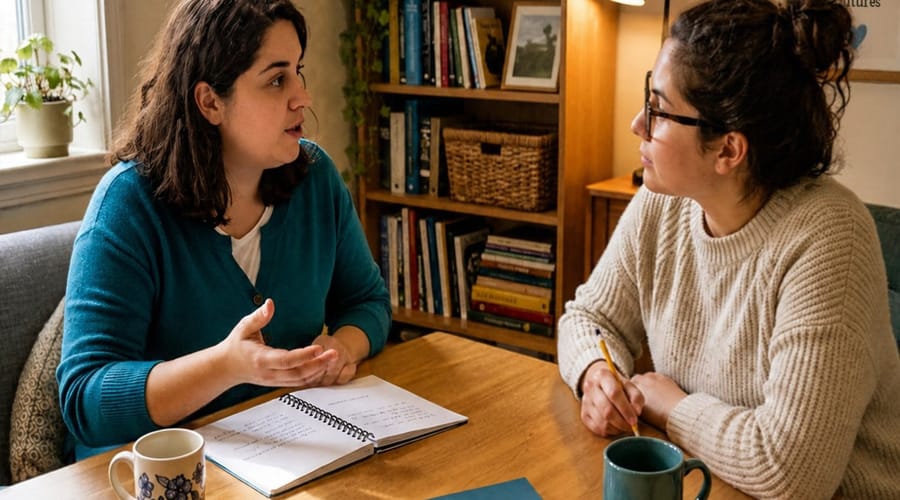
In short: Fear of speaking English doesn't go away with more grammar lessons. It goes away with speaking practice in a safe environment. Private lessons or a very small group help most, with a teacher who encourages you to speak even when you make mistakes. With the Berlitz method, lessons are taught in English and you start speaking from the very first lesson. In a private lesson, about 80% of the time is spent speaking, and group classes at the learning center have up to 5 students.
Why do we freeze when we need to speak?
- Translating in your head: You build the sentence in Hebrew and translate it, and meanwhile the conversation moves on.
- Perfectionism: You wait for the perfect sentence, so you end up saying nothing.
- A bad experience at school: Corrections in front of the class, grades, embarrassment.
- Too little speaking time: In large courses you hardly get to speak.
Which course helps you overcome the fear?
| Format | Why it helps | Best for |
|---|---|---|
| Private lessons | No audience, so you can make mistakes without embarrassment | People whose fear is especially strong |
| Small group (up to 5 students) | Everyone is at the same level and in the same boat | People who want support as well as conversation practice |
| A course taught entirely in English | You stop translating and start thinking in English | People who understand English but can't speak it |
| Regular practice between lessons | Speaking becomes a habit | An add-on to any course |
How the Berlitz method helps break the barrier
- Only the target language, from the first lesson. There's no time to translate, so you get used to answering directly in English.
- You speak, not the teacher. In a private Berlitz lesson, about 80% of the lesson is spent speaking, through role plays, quizzes and conversation.
- Immediate feedback during the conversation, as part of guided practice.
- Practice without an audience: Between lessons you can practice conversation with an AI-based virtual tutor with speech recognition.
- Real-life situations: The job interview preparation course, for example, includes conversation exercises designed specifically to reduce the fear of speaking and build confidence.
What to check in your first lesson
- Did you speak more than the teacher?
- Did the teacher interrupt you for every mistake?
- Did you feel comfortable making mistakes?
- How many students were in the group?
Tips for practicing between lessons
- Talk to yourself in English for one minute a day about what you did.
- Record a short voice message and listen to it.
- Learn set opening phrases for conversations, meetings and phone calls.
- Start with a few short sentences, not a speech.