Your Complete Holiday Survival Guide: Essential French & English Vocabulary for Christmas in Montréal
Author:
Berlitz
There's something magical about Montréal during the holiday season. Walk down Rue Sainte-Catherine and you'll hear "Joyeux Noël!" from one vendor and "Merry Christmas!" from the next. Step into a family gathering and you might find yourself discussing tourtière in French while debating the merits of eggnog in English—all within the same conversation.
This isn't just charming cultural quirk. It's the reality of celebrating the holidays in North America's most bilingual major city.
But here's where it gets interesting: knowing how to say "Merry Christmas" in both languages is nice. Understanding what a réveillon is, recognizing the significance of Boxing Day, or being able to order a slice of bûche de Noël with confidence—that's when you truly unlock the full Montréal holiday experience.
According to Statistics Canada's 2021 census, an impressive 58.5% of Montréal residents are bilingual in French and English. This creates a unique linguistic environment where the holidays become a living language lab—where every family dinner, market visit, and neighborhood party offers authentic opportunities to practice both languages naturally.
At Berlitz Montréal, we know that immersive learning isn't just about grammar rules—it's about cultural readiness. That's why we've created this complete survival guide: to help you move beyond basic greetings and step confidently into the bilingual celebration that defines Montréal's holidays.
Whether you're joining your first réveillon, navigating your inaugural Boxing Day shopping experience, or simply want to understand why everyone's so excited about tourtière, this guide has you covered.
Table of Contents
Essential Holiday Vocabulary: Your Bilingual Toolkit
1. Festive Greetings & Wishes: The Code-Switching Moment
In Montréal, knowing when and how to switch between French and English greetings is both an art and a practical skill. Here's your essential toolkit:
| English | French (Québécois) | When to Use |
| Merry Christmas | Joyeux Noël | Specifically for Christmas Day; more religious/traditional |
| Happy Holidays | Joyeuses Fêtes | Inclusive, covers entire season; very common in Québec |
| Happy New Year | Bonne Année | For New Year's Day and throughout January |
| Season's Greetings | Meilleurs Vœux | Formal, professional contexts; written cards |
| Best wishes | Mes meilleurs vœux | Slightly more personal than Season's Greetings |
| Have a wonderful holiday | Passez de belles Fêtes | Warm, friendly farewell during holiday season |
Expert Tip: Joyeux Noël vs. Joyeuses Fêtes
Understanding this distinction will make you sound like a local:
-
Joyeux Noël is specific to Christmas and has religious connotations. Use it when you know someone celebrates Christmas.
-
Joyeuses Fêtes (or simply "Bonnes Fêtes") is inclusive and covers the entire holiday period from Christmas through New Year. This is the safer, more commonly used option in multi-cultural Montréal.
In a business setting or when you're unsure of someone's traditions, "Joyeuses Fêtes" is your go-to choice.
Practice Phrase:
-
"Je vous souhaite de joyeuses Fêtes!" (I wish you happy holidays!)
-
"Merci, à vous aussi!" (Thank you, same to you!)
Want to master these conversational exchanges? Our French classes at Berlitz Montréal focus on real-world scenarios from day one.
2. The Québécois Holiday Table: Food & Drink
Food is the heart of Québécois holiday celebrations, and the vocabulary is distinctly local. Master these terms and you'll navigate any holiday gathering with confidence:
| English | French (Québécois) | Cultural Context |
| Meat pie | Tourtière | THE iconic Québec Christmas dish—spiced ground meat in pastry |
| Yule log (cake) | Bûche de Noël | Traditional chocolate log cake; every bakery makes them |
| Pork hocks stew | Ragoût de pattes (de cochon) | Traditional Québécois dish served at réveillon |
| Meat pie (general) | Pâté à la viande | Similar to tourtière but regional variations exist |
| Candy cane | Canne de Noël | Also: "canne en bonbon" |
| Eggnog | Lait de poule | Literal translation: "chicken milk"—creamy holiday drink |
| Mulled wine | Vin chaud | Served hot with spices; popular at Christmas markets |
| Sugar pie | Tarte au sucre | Classic Québécois dessert, often served during holidays |
| Maple taffy | Tire d'érable | Sometimes served as holiday treat; made with snow |
| Tourquette/Cipaille/Cipâte | Six-pâtes | Regional variation of layered meat pie |
The Tourtière Story:
If you attend only one Québécois holiday dinner, you'll encounter tourtière. This isn't just any meat pie—it's a cultural institution. Every family has their "secret" recipe, passed down through generations. Some use pork, others beef, many mix several meats. The spicing varies by region: Lac-Saint-Jean style often includes potatoes and game meat, while Montréal-area versions tend to be finer and more delicately spiced.
When someone offers you tourtière, the appropriate response is enthusiasm: "Oui, s'il vous plaît! J'adore la tourtière!" (Yes, please! I love tourtière!)
The Réveillon Feast:
Le réveillon is the traditional Christmas Eve dinner, and it's serious business in Québec. Starting late (often after midnight mass, though secular versions start earlier), it features multiple courses, family recipes, and can last well into the early morning hours.
Essential réveillon vocabulary:
-
"C'est l'heure du réveillon!" (It's time for the réveillon!)
-
"Qui a fait la tourtière?" (Who made the tourtière?)
-
"Puis-je avoir une autre portion?" (May I have another serving?)
-
"C'est délicieux!" (It's delicious!)
Learn how to navigate these cultural moments confidently with Berlitz Montréal's French courses, where cultural context is just as important as vocabulary.
3. Decorations & Settings: Around the House
Shopping for decorations or describing your holiday setup? You'll need this vocabulary:
| English | French (Québécois) | Usage Notes |
| Christmas tree | Sapin de Noël | "Sapin" specifically means fir tree |
| Ornaments | Boules (de Noël) | Literally "balls"; most common term in Québec |
| Decorations (general) | Décorations | Used for all types |
| Tinsel | Guirlande | Can also mean garland |
| Garland | Guirlande / Couronne | Couronne for wreath-style |
| Christmas stocking | Bas de Noël | "Bas" = stocking/sock in Québécois French |
| Fireplace | Cheminée | Essential for the Santa Claus story! |
| Christmas lights | Lumières de Noël | Also: "décorations lumineuses" |
| Wreath | Couronne | Often hung on doors |
| Star (tree topper) | Étoile | Traditional tree topper |
| Angel (tree topper) | Ange | Alternative tree topper |
| Nativity scene | Crèche de Noël | Still common in Québec homes |
| Advent calendar | Calendrier de l'Avent | Growing in popularity |
| Mistletoe | Gui | "Sous le gui" = under the mistletoe |
Québécois Distinction: "Bas de Noël"
In France, you might hear "chaussette de Noël," but in Québec, everyone says "bas de Noël." This is one of many vocabulary differences that sets Québécois French apart.
Shopping Conversations:
When you're at the Christmas market or décor store, these phrases will help:
-
"Je cherche des boules pour mon sapin." (I'm looking for ornaments for my tree.)
-
"Avez-vous des guirlandes lumineuses?" (Do you have string lights?)
-
"C'est combien pour la couronne?" (How much for the wreath?)
-
"Est-ce que c'est fait à la main?" (Is it handmade?)
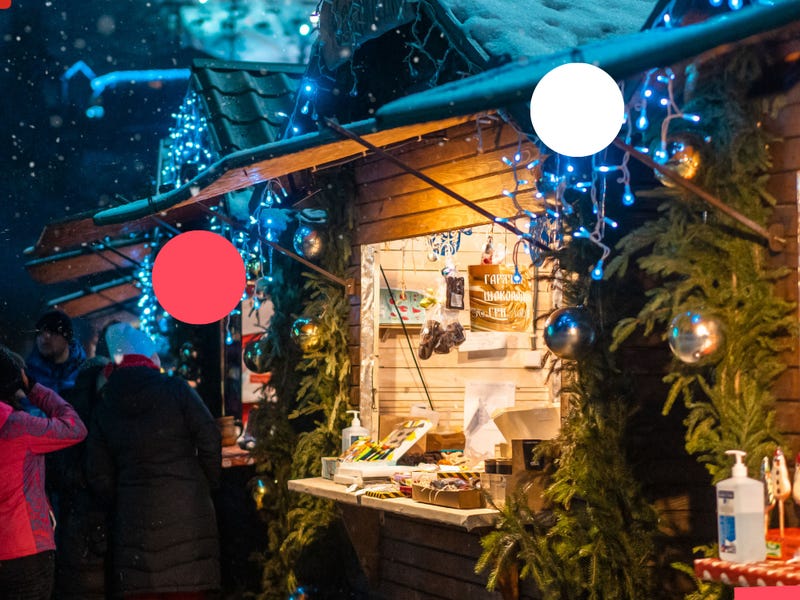
Practice Tip: Visit the Christmas markets on Rue Sainte-Catherine or at Place des Festivals and challenge yourself to describe what you see in both French and English.

4. Traditions & Activities: The Immersion Experience
Understanding holiday traditions means knowing the verbs and expressions that bring them to life:
| English | French (Québécois) | Cultural Context |
| Christmas Eve dinner | Le Réveillon | Traditionally after midnight mass; central Québec tradition |
| Midnight mass | La Messe de minuit | Religious service on Christmas Eve |
| Christmas Day | Le jour de Noël / Noël | December 25th |
| Boxing Day | Le Boxing Day / Lendemain de Noël | Dec 26; major shopping day in Canada |
| New Year's Eve | Le Réveillon du Jour de l'An / Veille du Jour de l'An | Another réveillon! |
| New Year's Day | Le Jour de l'An | January 1st |
| The Guignolée | La Guignolée | Traditional door-to-door charity collection |
| To go shopping | Faire du magasinage / Magasiner | Distinctly Québécois verb! |
| To trim the tree | Décorer le sapin | Family activity |
| To wrap gifts | Emballer / Empaqueter les cadeaux | Essential skill! |
| To send cards | Envoyer des cartes de vœux | Less common but still practiced |
| To sing carols | Chanter des cantiques / chants de Noël | "Minuit, chrétiens" is a classic |
| To exchange gifts | Échanger des cadeaux | Usually done on Christmas Day |
| To make a toast | Porter un toast / Trinquer | "Santé!" or "À votre santé!" |
La Guignolée: A Living Tradition
La Guignolée is a uniquely Québécois tradition that dates back to New France. Groups (often youth groups, scouts, or community organizations) go door-to-door collecting food and money for those in need, singing traditional songs. If you hear "Bonjour le maître et la maîtresse!" at your door in December, it's la Guignolée!
The appropriate response: "Entrez, entrez!" and donate what you can.
Boxing Day in Canada:
While not originally French-Canadian, Boxing Day (December 26) has become a major cultural event across Canada, including Québec. You'll hear:
-
"Tu vas magasiner le Boxing Day?" (Are you going shopping on Boxing Day?)
-
"Les soldes du Boxing Day commencent à quelle heure?" (What time do the Boxing Day sales start?)
-
"J'ai trouvé des aubaines incroyables!" (I found incredible deals!)
Essential Action Phrases:
-
"On décore le sapin ce soir?" (Shall we decorate the tree tonight?)
-
"Je dois aller magasiner pour les cadeaux." (I need to go shopping for gifts.)
-
"As-tu emballé tous tes cadeaux?" (Have you wrapped all your gifts?)
-
"On va à la messe de minuit?" (Are we going to midnight mass?)
-
"Le réveillon commence à quelle heure?" (What time does the réveillon start?)
Perfect your conversational French for these social situations with our group classes or private lessons at Berlitz Montréal.
5. Gift-Giving Vocabulary: The Exchange
No holiday is complete without gift-giving. Here's the essential vocabulary:
| English | French (Québécois) |
| Gift / Present | Cadeau |
| To give a gift | Offrir un cadeau / Donner un cadeau |
| Gift wrapping | Emballage cadeau |
| Gift receipt | Reçu cadeau |
| To exchange/return | Échanger / Retourner |
| Thank you for the gift | Merci pour le cadeau |
| You shouldn't have! | Il ne fallait pas! |
| I love it! | J'adore! / Je l'adore! |
| It's perfect! | C'est parfait! |
| Exactly what I wanted | C'est exactement ce que je voulais |
| Secret Santa | Père Noël secret / Échange de cadeaux |
| Stocking stuffer | Petits cadeaux pour le bas de Noël |
Gift-Giving Etiquette Phrases:
When receiving a gift:
-
"Oh! Merci beaucoup! Il ne fallait pas!" (Oh! Thank you so much! You shouldn't have!)
-
"C'est vraiment gentil de ta part." (That's really kind of you.)
-
"J'adore! Comment as-tu su?" (I love it! How did you know?)
When giving a gift:
-
"J'espère que ça va te plaire." (I hope you'll like it.)
-
"C'est juste une petite chose." (It's just a little something.)
-
"Joyeuses Fêtes!" (Happy Holidays!)
Berlitz Expert Tip: Mastering Holiday Code-Switching
At Berlitz Montréal, we teach more than vocabulary—we teach cultural fluency. Here's an expert strategy that our instructors use to help students become comfortable with Montréal's bilingual reality:
The "Bilingual Basket" Exercise
This simple practice technique will boost your confidence faster than any textbook:
Step 1: Create two shopping lists—one entirely in French, one entirely in English.
Step 2: Visit two different stores or market sections, committing to speak only the list's language with each vendor.
Step 3: Don't switch! If a vendor responds in the other language, politely continue in your chosen language: "Je préfère pratiquer mon français" (I prefer to practice my French) or "I'm working on my English."
This exercise trains your brain to commit to a language context without anxiety, building the muscle memory for real-world code-switching.
Parisian French vs. Québécois French: Celebrating the Difference
If you've learned French elsewhere, you might notice some differences in Québec. This isn't "wrong" French—it's Québécois French, with its own rich history and legitimacy.
Key differences you'll notice during the holidays:
| Québécois | Parisian/International French |
| Magasiner | Faire du shopping / Faire les courses |
| Bas de Noël | Chaussette de Noël |
| Breuvage | Boisson |
| Char (informal) | Voiture |
| Dispendieux | Cher |
| Barrer (la porte) | Fermer à clé |
Why this matters: Using local vocabulary like "magasiner" instead of "faire du shopping" signals respect and cultural awareness. Montréal vendors and hosts appreciate when learners embrace the local language, regardless of accent or fluency level.
The Bottom Line: Perfection isn't the goal—connection is. Montrealers are famously welcoming to language learners. Making the effort to use the local language and expressions will open more doors than perfect grammar ever could.
Want to learn the nuances of Québécois French from native speakers who understand the cultural context? Visit our language school Berlitz Montréal where local expertise meets proven methodology.
Quick Reference: Your Holiday Phrasebook
At the Market / Store:
French:
-
"Bonjour! Avez-vous de la tourtière?" (Hello! Do you have tourtière?)
-
"C'est combien?" (How much is it?)
-
"Je vais prendre ça." (I'll take that.)
-
"Acceptez-vous les cartes?" (Do you accept cards?)
-
"Merci, joyeuses Fêtes!" (Thank you, happy holidays!)
English:
-
"Hi! Do you have any Yule logs left?"
-
"How much is that?"
-
"I'll take two, please."
-
"Do you take credit cards?"
-
"Thanks, happy holidays!"
At a Holiday Gathering:
French:
-
"Merci de m'avoir invité(e)!" (Thank you for inviting me!)
-
"Ça sent tellement bon!" (It smells so good!)
-
"Qui a fait cette tourtière? C'est délicieux!" (Who made this tourtière? It's delicious!)
-
"Puis-je vous aider à préparer quelque chose?" (Can I help you prepare something?)
-
"Joyeuses Fêtes à toute votre famille!" (Happy holidays to your whole family!)
English:
-
"Thanks so much for having me!"
-
"Everything smells amazing!"
-
"Who made this meat pie? It's incredible!"
-
"Can I help with anything in the kitchen?"
-
"Happy holidays to you and your family!"
Making Toasts:
French:
-
"Santé!" (Cheers! / To health!)
-
"À votre santé!" (To your health! - formal)
-
"Joyeux Noël à tous!" (Merry Christmas everyone!)
-
"Bonne Année!" (Happy New Year!)
English:
-
"Cheers!"
-
"To your health!"
-
"Merry Christmas everyone!"
-
"Happy New Year!"
Make This Your Breakthrough Holiday Season
Montréal's holiday season offers something truly special: a low-stakes, joyful environment where language learning happens naturally. Every réveillon invitation, every Christmas market visit, every Boxing Day shopping trip becomes an opportunity to practice real French and English with real people in real situations.
But here's what experienced language learners know: vocabulary lists are just the beginning. True confidence comes from structured practice that prepares you for authentic conversations.
That's where Berlitz Montréal makes the difference.
Why Berlitz for Holiday Language Success?
✅ Cultural Context: We don't just teach words—we explain when and how to use them in Montréal's unique bilingual environment
✅ Immersive Method: Our proven Berlitz Method® focuses on conversational skills from day one
✅ Local Expertise: Our instructors are native speakers who understand Québécois culture and traditions
✅ Flexible Options: Learn on your schedule with options that fit your life
Your Next Step: Choose Your Path
Whether you need French classes to join that réveillon with confidence, or English classes to navigate Boxing Day shopping like a pro, we offer flexible solutions:
Private Lessons:
-
One-on-one instruction tailored to your goals
-
Focus on holiday vocabulary and cultural situations
-
Flexible scheduling around your busy season
Group Classes:
-
Learn with fellow students in a supportive environment
-
Practice holiday conversations in realistic scenarios
-
Build community while building skills
-
Learn from anywhere with live instruction
-
Same quality teaching, maximum flexibility
-
Perfect for busy holiday schedules
-
Immersive experience at our downtown Montréal location
-
Face-to-face conversation practice
-
Direct access to cultural nuances and corrections
Your Holiday Challenge: Move Beyond the Vocabulary List
This temps des fêtes, challenge yourself to move past simple greetings and engage in real conversations. Order that tourtière with confidence. Accept that réveillon invitation. Navigate the Boxing Day crowds while practicing your target language. Make this holiday season the turning point in your language journey.
Ready to gain the confidence to lead holiday conversations?
Visit Berlitz Montréal at 1470 Peel Street, Suite 316 (right across from McGill University), or explore our flexible online classes to start learning today.
Don't let another holiday season pass without experiencing the full magic of bilingual Montréal. Whether you're preparing for your first réveillon or your fiftieth, there's always something new to learn—and always someone eager to share their traditions with you.
Start your journey today and make the next temps des fêtes your most confident yet.
Joyeuses Fêtes et bon apprentissage! 🎄
Looking for more ways to immerse yourself in Montréal's bilingual culture? Check out our guide to Christmas markets in Montréal and discover how everyday experiences can accelerate your language learning.
.png?auto=webp&format=pjpg&quality=80&width=800&height=800&fit=crop&crop=800:600,smart)