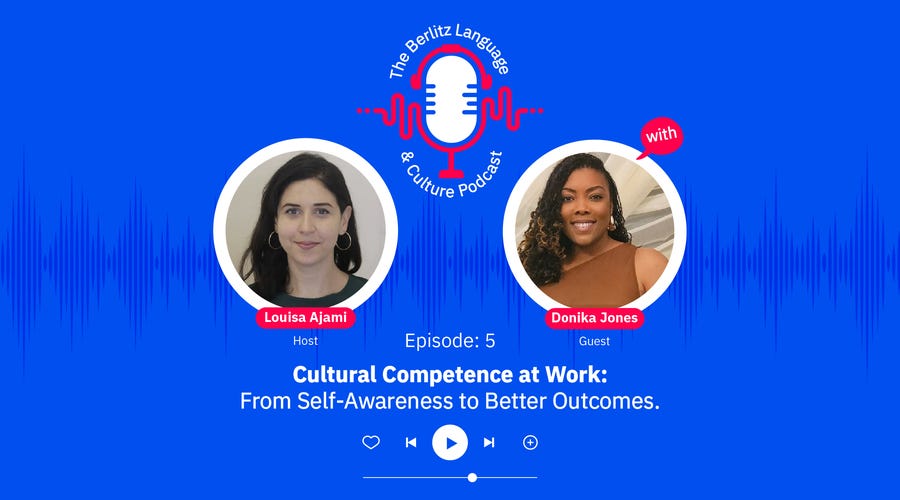
"Cultural Competence at Work: From Self-Awareness to Better Outcomes" with Donika Jones [Podcast]
Author:
Berlitz
In this episode of the Berlitz Culture Podcast, we sit down with public health practitioner, business strategist, and stakeholder engagement specialist Donika Jones. With years of experience helping organizations strengthen their cross-cultural competence, Donika brings a unique perspective on how cultural awareness can transform program development, workplace dynamics, and business outcomes.
From understanding our own cultural lenses to building more inclusive, responsive, and effective programs, Donika takes us through the essential components of culturally competent work—and why humility, engagement, and integrated thinking matter now more than ever.
Join host Louisa Ajami as she and Donika explore practical approaches, real-world challenges, and the powerful opportunities that emerge when we design with culture at the center.
Transcription Episode 5
(INTRO) Donika Jones: You have to be mindful, and you have to make sure that you have the right individuals at the table, not just in terms of, you know, leadership, but also that you have representatives or representation from different communities, individuals with different ideas, different groups.
Louisa Ajami: Hello, everyone, and welcome to the Berlitz Culture Podcast. Today, we are delighted to have public health practitioner, business strategist, and stakeholder engagement specialist Danika Jones. Danika has worked with companies and agencies to build their cross-cultural competence skills and to improve their capacity to work, engage, and collaborate across cultures. She's also worked with companies and agencies to align strategic plans with stakeholders' priorities. Welcome Danika.
Donika Jones: Thank you. It's a pleasure to be here now.
Louisa Ajami: We have had the pleasure of working together before, and we're excited to hear your insights on Culturally Responsive Programming and planning in the workplace. So it's great to have you.
Donika Jones: Thank you. I'm looking forward to it. It's always great to work with you.
Louisa Ajami: So just to begin, we've worked with you in this area quite a bit in the past, and you're quite good at what you do. I did want to know, why is it important to include an understanding of cultural competence and program development in wider business development?
Donika Jones: Right. Um, you know it's to begin. It really requires you to acknowledge that there are differences in the ways that we experience the world, that there are differences in our perspectives, and it gives us the opportunity to think differently about how we want to develop programs and how we want to do our business. So when we include cultural competence in anything that we're doing, whether it is, you know, business or program development, we can automatically start to think about how we do this differently to make sure that we're engaging with a particular community, a specific target group? How do we need to think about this differently? How do we approach it differently? What are some of the needs? And because we're doing that, we are, we're able to develop a better product and program. So that's one reason, and that takes me to the second point, which is that we're actually able to develop more inclusive and tailored programs. So when we're, you know, thinking about being culturally competent, and we're developing programs and products, the only way that we're going to know or be able to develop a different program is to be able to work across cultures and to be able to ask questions so like, what is it that you need? What has to happen? And so when we develop or when we have a better understanding of what those needs are, what those cultural customs are, we are in a better position to meet the needs through those products and those services.
Louisa Ajami: Now, I like what you said earlier, because it gives us an opportunity to think differently, and you used the word opportunity, and I think that's very important when you're doing these programs, and whether they're for program development or just general business development, that you look at differences as an opportunity, and you mentioned that again in your answer to this question, especially when you're trying to reach targeted groups and communities that you might not be that familiar with yourself.
Donika Jones: Absolutely, because that's really what it is, right? So whether it's that we want to, we don't, we don't have the resources to waste. And so if it's a product that we're developing, or if it's a program that we're trying to implement, if we really want it to be good, we have an opportunity to create in a different way, to incorporate different elements or different aspects that are relevant to communities. And I think that that is a huge opportunity that we have, not just on both ends, both for, you know, the programs and the businesses, but actually for the communities to have better outcomes, to experience things differently, to have more tailored to have things that are better tailored to suit their needs.
Louisa Ajami: Now you work regularly with learning and development professionals across different functions and different types of organizations. If you are building a program or building some type of training as an L&D professional, what should they know about including cultural competence in their training?
Donika Jones: One of the things that is so important is to really facilitate conversation around self awareness, so we sometimes go into things not really being aware that the way that we think about things ourselves, the way that we experience things, is actually influenced by our culture, our age, the languages that we speak, all of those factors and in, you know, trainings, it's important to give trainees the opportunity and the time and to really encourage them to think. About what does that look like from your own perspective? Are you aware of how you view the world and the factors that impact you? Because once you're able to think about, well, this is how I see it, you can create space and an awareness to accept that. Well, that's just the way I see it. But there are others who may see it or experience it, or may have a different perspective. And in doing that, I really think that we are able to shift to a place where, hopefully, you know, not only are we open to understanding that others may see things differently, but we create space to integrate those other views and perspectives as well. So in terms of learning and development, the focus on self-awareness is really important. The other thing that I would say is to emphasize the importance of how relevant cultural competency is in terms of integrating it, as opposed to adding it on. And so we often will, you know, we develop these wonderful programs or these services or these products, and we, if we're not careful, we'll get into the mindset that says, well, we just have to tweak one more thing. We'll keep it the way it is, and it'll be appropriate for, you know, a particular community or a certain demographic, and that's really not the case. So, looking at cultural competency and explaining that it's not something that you do at the end or at one point, but it's something that you're integrating throughout the entirety of your program development, your product development, and that you're thinking about it at each stage. So I think that it is really important to make sure that you know you're thinking about it along the way. And a part of that is encouraging individuals to be aware of what they may be missing. So always asking that question, like, are we missing something? Is there something else that we haven't thought about but really encouraging individuals to train or retrain the way that they think and how they approach program development, product development, business development, so that you're really integrating that cultural competency, that awareness, that openness, and thinking about different ways of doing things.
Louisa Ajami: Now, here in our approach, the cultural orientations approach that we use as the basis for all of our programs here at Berlitz, self-awareness is the first step towards cultural competence. And so with a sense of self-awareness, as you said, you can be open to the idea that there are blind spots that you have that can be filled with someone else's expertise, someone perhaps from a different cultural background. And so it's important to be able to understand that whereas you might have great ideas and be important member of the team, there could be areas that require a little more exploration, and that maybe perhaps being open to ideas of someone else having that insight, that specific background, or the experience in that area, to be able to fill in the gaps that that we ourselves might have.
Donika Jones: Absolutely, absolutely, I think it's almost like you're working from two different ends, right? So you're really able to work collaboratively, to think about how you integrate all of that? And that is so important to some of the work that I've been able to do, where it's like you're hearing you have one way of doing it, or a company has one way of doing it. But once you start to engage, or you start to connect, or you think about it from more, you know, more of a culturally competent place, you're able to really see how you can weave those together and integrate that to actually translate that into work, whether that's a strategic plan, a work plan, a new program or business, but they all come together and they align to produce something better in the end.
Louisa Ajami: And now we're talking about cultural differences and differences of background. Some people might be on a team that was made up of people all from the same geographic region, or maybe they're all the same age group, or maybe they've all had similar experiences. They're in a similar place in their career. For example, what does cultural competence matter? If you have a very homogeneous team, they might say. Well, we're all from the same country. We all had the same major in college. What does it mean if we seem to be homogeneous culturally?
Donika Jones: I think it matters a lot. Not. I think it does. It matters a lot in the sense that when you are working on a team, and there's, you know, that shared experience and people have, you know, similar ideas, it can be very easy to get into the mindset that, because we all think this way, everybody thinks this way. So it's so important that when that is the case, you have a homogeneous team. Mean that you are intentional about seeking other perspectives, that You are mindful that even though you all may be thinking the same or you may have similar thoughts and ideas, that you take steps to it's really important that you take steps to seek out different perspectives and to look for new ideas. And that might look like, you know, having others join your project team. So it might also look like, you know, we talked about engagement. So there are different ways that you can do it, but it's really important for you to actively seek out and be intention, intentional about looking for different perspectives. Because if you don't, you're really going to get caught in that trap where you're thinking everybody on the team thinks this way. So this is it, we've liked. Why else would I think differently? Because we all think this way. So if you're not careful, it could really, really blind the way that you think and the way that you move forward with programs or projects and how you develop different services.
Louisa Ajami: And I think we've seen the result of that kind of groupthink many times. There are so many examples, for example, of advertisers really missing the mark of who they're addressing when they're putting together a campaign or groups targeting a certain audience, but really not using the right approach to dealing with that. So there are a lot of places that could go wrong if you've been sort of bound by this group, think assuming that everyone will have the same response to an idea or a program or any type of initiative as the people on your team might be having.
Donika Jones: Absolutely, and I love that example that you shared, because it is a very real example where you get to the end, and you're like, Oh, this is going to be perfect, and you don't get the response. You may actually turn people off. You, you know it, it's almost you get to a point where you now have to do damage control, but you also have to start from scratch over again, because the approach that you use was just not appropriate. And so really, to counter that you you have to be mindful, and you have to make sure that you have the right individuals at the table, not just in terms of, you know, leadership, but also that you have representatives or representation from different communities, individuals with different ideas, different groups. And I would say also, even in doing that, being careful to not assume that, how would I frame it, that even though you may have individuals who, let's say, represent a specific group, that they speak for the group, so that understanding that you know what this is, this is one aspect of a community, and yeah, this is going to make us more informed. We're going to be able to develop a better project. But this is not the only perspective that exists within the community. So, depending on how tailored you want this to be, you may have to then, you know, look at different sub-segments of that group. You know, you may have to be thinking about language. Then from that perspective, you may have to think about age or, you know, different factors that might again continue to influence how those that you're connecting with and engaging with, how the responses that they may give you, but how that might also shift in subsections or sub-communities that you're connecting with and speaking to.
Louisa Ajami: So just generally, developing a great awareness of what your target is and how best your team works, how best to leverage all of the different viewpoints, backgrounds on the team, and perhaps even admit that you might need to expand a little bit and work a little bit on some blind spots that you might have, or even just acknowledge that there are blind spots.
Donika Jones: Absolutely, absolutely and you have to be so humble to be able to do that, because often, especially in leadership, there's this expectation that you know everything, and to you know, I would say this probably even goes back to the training, but to really highlight the input, the importance of humility and cultural humility, and knowing that you may Be a leader in one area, or you may have a strong skill set in another area, but that doesn't mean that you know everything about everything. And I always like to say communities will tell you what they need if you ask. And to be humble enough to say you may be the CEO or whomever it is, or the team leader, you know you may have been in your role for 30 years, but to know that you may not know all of the answers when it comes to working across cultures and being humble enough to receive and to hear and to even implement what it is that is being shared with you is so important to be able to move work forward and to integrate cultural competence in the work. That's happening now.
Louisa Ajami: You mentioned team leaders and organizational leaders here, and they're often the ones who are most impactful in setting the sort of general culture of the organization or of the team or of the department they work in. How does a team leader's culture impact the way that they make decisions, delegate, and plan, and what can they do to ensure that their own personal cultural orientations or profile doesn't interfere with broader, more understanding, and open leadership?
Donika Jones: That is, it's a great question, because the reality is, we're all bringing some element of ourselves to our leadership, and that could be impacted by our culture or, you know, our experiences or our age. So every leader is coming with something, and, of course, to varying degrees, their culture is going to influence how they make decisions and how they delegate and do things. The problem is when leaders think that it is only their culture that is really going to influence the decisions, and when they do that, they're they're they're leading, or they're managing from this place where they're only seeing their way of doing something. So I go back to being intentional and a leader. Leaders need to be aware of whether it's a blind spot or, you know, a challenge that they may fall into in not being open or not actively seeking out different perspectives. So that may look like, you know, them thinking about the diversity of their team and what they may need to include in terms of how they solicit information, or how they gather information, how they include their team in meetings, how they create space for people on their team to share. Because if leaders are not aware of, you know, how their own culture will impact their decisions, that can have an impact, as we've been talking about, on programs and services and products that are developed, but also on team dynamics. So you know, you may culturally come from a place where leadership is not just about the position that you have, but you know, be, yeah, you may come from a culture where, let's say, management is only associated with your position, whereas for some, you know, management is also connected to leadership, and leadership to management. And so those individuals may have the idea that they're able to contribute in a variety of ways, they may be more open to sharing their thoughts. And if you have someone who is not from that school of thought, they may not create space for that. And that could really shift the dynamic in the team. Or they may come from a culture where you have to ask you know someone, you have to wait until you're asked to share your opinion, so little things like that, where you know, as a leader, you have to be aware that, okay, well, your team might be silent in this meeting. Why is that like? Maybe we need to have a conversation about, like, what is the best way for you to communicate? How do you like to share your ideas? You know, it's really important for a leader to be mindful and intentional, and, you know, self aware to make sure that they're thinking about all of these factors and how how they impact their leadership, their delegation, the growth of their team, as well as the programs and the projects, and, you know, the businesses that are being developed under their leadership.
Louisa Ajami: Now, throughout all of your work in this area, for all of the years of experience that you have, have you been able to see some best practices when it comes to program development and then wider business development at all?
Donika Jones: Right, I i like to call them promising practices, because I don't know when I hear the word best. I always think that there is only one right. I think that when I think of promising practices, I think of what are a number of things that we can do to, you know, improve or to really integrate cultural competence into program development. The first one that I think of is around stakeholder or community engagement. And you know, I go back to we don't know what we don't know unless we ask, and communities know, or stakeholders know what they need and will articulate that in the best way. And so it's really important to have a clear understanding of what that looks like, and to be able to engage and again, seek new ideas, get different perspectives, but also start to build new partnerships that can completely shift how you do your work moving forward. The other thing that I would mention, and we talked about this too, is the idea of integrating throughout. Instead of adding on and really thinking about what are the different ways that you can continue to engage, or you continue to ask questions about those blind spots and be responsive throughout the entirety of your program or project development, and integrate that the same way that you would have, you know, milestones, or that you would develop indicators to track other things. Have some indicators to really track. You know, whether it's your engagement or the blind spots that you've identified that you're continuing to track how you're addressing them throughout the entirety of the project, and even afterwards, how are you going to circle back to the community, right, which goes back to the engagement? So that would be the second one, that integration and integration, as opposed to adding on, and the third one, another one that we've talked about, is humility, that importance that we place on being humble enough to say, I don't know this, and somebody knows it better, and I can learn from them, and I can integrate what they're saying, even though it's not coming from me. And I think that has a lot to do with recognizing and seeing the importance of the value of other knowledge systems, if you will, there is value in other ways of doing things and individuals. Just because it's different than mine doesn't mean it's any less valuable, and giving space for that, so the humility, integration, and stakeholder community engagement would be three promising practices that are integral.
Louisa Ajami: I think those are promising practices everywhere in business, not just when it comes to program planning and business development as well. I think those are great ideas for everyone in any level as well.
Donika Jones: And I appreciate you saying that, because sometimes when we think of cultural competence, we think, Oh, it's so different. There's so many different there's so many different things that we have to do. And yeah, there are things that we will have to tailor. There are things that we have to see differently. However, at a very basic level, there are things that we're already doing. We just need to shift our mindset about how we do them, and be open to the different perspectives and do those things in different ways.
Louisa Ajami: Well. Thank you so much for sharing your expertise and your insights after so many years in this practice. I want to thank Danica again for everything she shared with us and your promising practices as well, which can be used by anyone in any function, in any phase of their career, in any type of industry. Please join us for more on the Berlitz culture podcast, for more expertise and insights from our guests on a number of topics. Thanks again. Danika.
Donika Jones: Thank you. Thank you. Bye.
Explore more of our Berlitz Language and Culture Podcast here.
.jpg?auto=webp&format=pjpg&quality=80&width=800&height=800&fit=crop&crop=800:600,smart)