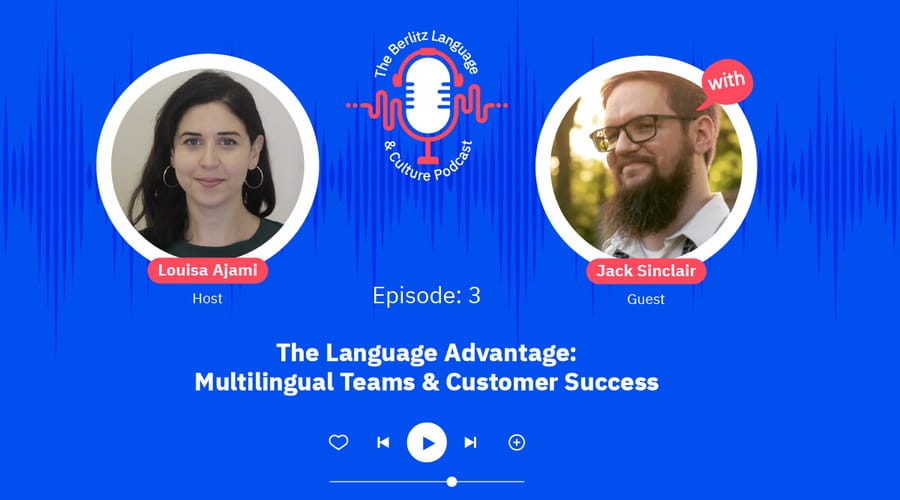
"The Language Advantage: Multilingual Teams & Customer Success" with Jack Sinclair [Podcast]
Author:
Berlitz
In this episode, we talk with Jack Sinclair, an expert in international team leadership and language training, about the power of multilingual communication in BPO and customer retention.
Jack explains why language skills are more than a perk, they're a strategic advantage, especially during role changes or culturally sensitive situations. He also shares practical tips on hiring diverse assessors, active listening, and navigating difficult conversations.
Plus, get insights on regional and generational communication, from talking with kids to adapting to Southern-paced dialogue.
If you manage global teams or handle customer service, this episode will reshape how you view language, culture, and connection.
Transcription Episode 3
(INTRO) Jack Sinclair: Most people who are very frustrated in this world just want to be listened to.
Louisa Ajami: Welcome to the Berlitz language and culture Podcast. Today we're excited to welcome Jack Sinclair. Jack has got extensive experience on international intact teams, specifically within the fields of business process outsourcing and client retention. He's also worked on language testing and training and improvement programming in the companies he's worked for, specifically for markets in Southeast Asia, now based in Houston, Texas, Jack is joining us to talk about his professional experience and the challenges and opportunities of working across regions and cultures. Welcome today. Jack,
Jack Sinclair: Thanks, Lisa, it's nice to be here.
Louisa Ajami: Jack, can you tell us a little bit about your experiences in language testing and training? For example, who were the clients requesting training and what was their expected outcome for language testing and training?
Jack Sinclair: I worked with my previous company for about 10 plus years, and we worked with a variety of different clients that were looking at training for language testing, doing language improvement for their existing employees, or using testing as kind of a filter for the application process, so their outcomes kind of varied, but they always wanted to have the best language speaker some, sometimes they had expectations that were a little higher than that were realistic.
Louisa Ajami: And so for the listeners, B2 and C2 are both levels of comprehension and ability to interact in the other languages. And here at Berlitz, we know a lot about language training, of course, because that's how the organization started. Jack what were the languages your clients were hoping to engage their staff with?
Jack Sinclair: So it was a it was a kind of a spectrum. So we had a combination of English and Spanish, primarily from my team. We had some people looking for French, specifically regional French. In Canada, we tested for Canadian French. And then in Southeast Asia, we also looked at things like Japanese and Chinese as well. We looked at German a broad spectrum of languages, pretty much any language you think that somebody could look for, we ended up trying to test for at some point or another.
Louisa Ajami: And as any of us who have ever tried to learn languages know, some languages are a lot easier to learn than others, and some languages require a lot more time and dedication. So, what is the value for companies to have multilingual staff beyond their simple ability to interact with customers from different regions of the world? So, for example, how does being multilingual help those who've gone through language training, even if they don't stay in the role that they for which they receive the language training?
Jack Sinclair: One thing that helps if they don't continue in the language they tested in, it gives them kind of like a backup skill, and helps them be dynamic. The world of BPO is a world of movement. So people are moving from role to role. Very often, you'll find so for part of the year, they might work supporting a program for billing in one language, and then maybe that program ramps down, and then another one comes up, and it's for selling tickets to sporting events. So they have to be pretty dynamic with the needs, and maintaining that second language there gives them a second avenue to explore. One of the things that we always liked about our team was we had assessors from different countries. So it wasn't all assessors from the US assessing English. For example, we had people in India or the Philippines or Colombia, and they all spoke English very well, but they also spoke their native languages, like Spanish or Telugu. But it was it was very nice in that respect too, because they could put themselves in the shoes of the people we were testing and training, and they could see the mistakes that they are making, and understand and see things that our other agents couldn't see. I, for example, wouldn't know certain idiomatic expressions that might pop up in Telugu, but we might have our Indian agents see it, or they might notice certain filler words that other agents wouldn't notice. So. It was, it was nice having them in that respect, because they could catch things and then we could learn from each other as well.
Louisa Ajami: Yeah, absolutely, absolutely. And it's also I feel, you know, when I was going through the process of learning French, for example, it helped me increase my curiosity about the way that languages operate and about the way they spread as well. So for example, when you're learning one of the Romance languages, you can see similarities between the other languages as well, and that's similar to all languages that come from larger language groups. So you know, once you learn one, you're sort of a few steps into learning the other one as well. So it's a constant source of expansion for your mind. So Jack in your current role, you work a lot on the customer facing side, and from my conversations with you previously, a lot of it is solving problems and putting out fires, so to speak, as well as handling complaints. Do you have a communication style that you adopt to handle situations that are potentially tense?
Jack Sinclair: Absolutely so similar to how I navigate through life, I try to, kind of like ease people down into a more comfortable state in a communication I try not to have very high energy conversations with people in customer service, because that's usually when people make really rash decisions. They get upset or angry or sad, so I can kind of express this mood of just being chill on a call. It usually helps bring things down and removes a lot of potential issues. I very often talk to people, and then at the end they tell me, You know what, I came in here and I was feeling really hot headed, and I was saying a lot of really inappropriate things, but by the end of the call, I feel a lot better. So that's usually my goal. If I can get at least one person to say that a day, I feel like I've accomplished something. Some people don't say it, but I can hear it in their voice, so that's usually how I kind of adopt that it's a tone using active listening to just let them vent. I think the biggest downfall that customer service agents might have is adopting a here's a problem I need to immediately fix it instead of let's just let them talk it out for a second, and then you can you already know the answer to the problem, but if you tell them right now, they're going to be super mad. So let's let them talk it out for a second, tire themselves out, kind of like a an angry toddler, and then once they they calm down, then they'll be more willing to listen.
Louisa Ajami: Yeah, I think active listening is a skill that is not often emphasized enough. But what active listening does, and you know, for me as a customer too, every once in a while, I have to call in to one of those places for customer service, and if the person on the other end gives me the space to talk, I know I'm being listened to, and that diffuses the situation. And I think it probably works very well on situations that are easy to escalate. For example, if the person is very upset, if the person is very frustrated, I think active listening is a skill that's not talked about a lot, but it's so effective and diffusing tense or frustrated customer service situations. And I say that you know as a customer as well. People who have you know as a person who's waited online for a while, sometimes waited for someone to answer the phone, and by the time someone answers, you've got a lot of frustration pent up, and you don't want to yell at them, because obviously it's not their fault, but at the same time, you need to express your frustration.
Jack Sinclair: And I think some people also kind of think that it's a cheesy thing, but it does. It does work. Most people who are very frustrated in this world just want to be listened to for once in their life. So give them a moment to stand on their box and talk about something, even if it's something that you don't agree with. You know, politically or personally, I don't really take anything out of a call. If somebody says something I don't agree with, I just let them talk for a second. That's a pretty powerful thing. Most people don't feel like they're very listened to. So it's definitely a thing I recommend for most people to try to adopt.
Louisa Ajami: Yeah, outside of work too. I think, as you mentioned, you know, like with little kids, this is something that works across a large spectrum of circumstances, being an active listener, and that also gives you yourself time to formulate your thoughts and to think of a way to respond, doesn't it?
Jack Sinclair: Yeah, if you spend less time trying to react to every little thing that they say and just take it all in, because there's usually just one thing they're trying to accomplish. And a lot of these little things are just, you know, they're not mad about this thing or that thing. They're mad about this other thing. So just listen, let them talk, and then go, okay, is this your? Biggest issue, yep, okay, let's work on that.
Louisa Ajami: It sounds like an all around good way to approach customer service, whether it's over the phone or face to face, regardless of the industry.
Jack Sinclair: Absolutely.
Louisa Ajami: Now, in your current role, as mentioned, you're in the United States, and most of the customers that you speak to are also in the US, but regardless of the shared location, the shared geography. Have you noticed any cultural differences that impact how you help the customers? For example, the age of the customer, what region of the US they're in, what sort of customer service they're receiving? For example…
Jack Sinclair: Who would say so, you know, things in the in the south, for example, are a little slower, so people don't like to go too fast in a conversation. When they're from the south, they like to, you know, make sure, I like to make sure that they are at the same speed that I'm going. And sometimes I have to slow myself down. So if I notice I'm talking to somebody from the south, I try to slow things down a little bit. People from the north, on the other hand, to go a little bit faster. So I try to be very efficient when I'm talking to people from, say, New York or New Jersey or something, when I'm talking to children again, it comes back to listening. I always just assume that there's this moment in their life where they feel like they haven't been listened to by adults, which I feel like is a common thing for most children, so just giving them a moment to, you know, be heard, usually helps figure out what they need. Sometimes, kids don't like to express themselves, so you have to ask open ended questions to them instead of closed ended questions, because they will grab onto that and just give you a yes or no. And if you're looking for more detail, yes or no, doesn't help. So you really have to kind of gear your conversation to who you're talking to, because it's not one script for everybody. It's never going to work like that.
Louisa Ajami: All sorts of flexibility are required to be able to adjust to the person you're speaking to and what their needs are now, in our first podcast episode in this series, we spoke to communication expert Maria gorettananda, if anyone wants to check that episode out, if you haven't already, and she talked a little bit about the generational side of talking on the phone. So since you mentioned young people on this call, do you think it's harder for them, for the younger generations to pick up the phone and make a call.
Jack Sinclair: I've talked to young people who don't like using email, and then I've talked to older people who were really into tech, and they're perfectly fine with email, and I see them responding from their iPhones and stuff, and it just it seems to vary so much. I mean, I know most people don't cherish the idea of talking on the phone with most people, because talking to strangers is scary unless it's your job. So I think that's maybe the common factor for a lot of people, is just talking to somebody that you have never talked to before is a little bit of a tense situation.
Louisa Ajami: Thank you for joining us, Jack. Thank you for sharing your expertise and your time with us today. To our listeners, thank you for tuning in, and please join us again on the Berlitz Language and Culture Podcast.
Explore more of our Berlitz Language and Culture Podcast, here.
.jpg?auto=webp&format=pjpg&quality=80&width=800&height=800&fit=crop&crop=800:600,smart)