AI already drives everyday workplace communication

Most white-collar professionals are already using AI on a regular basis to write, edit, proofread, summarize, transcribe, and translate. They draft emails, summarize chats, create documents, prepare talking points, rehearse conversations, attend meetings with AI translation, and read AI-generated minutes. Even if written production is being automated much faster than live, spoken interactions, the breadth of AI-assisted communication puts companies in uncharted territory.

This is happening at every level of the organization. Executives use AI to discuss strategy, align with the C-suite, communicate operational plans, and prepare public remarks. Managers use it to prepare for difficult feedback conversations, summarize project discussions, and draft messages to clients. Team members rely on it to report to supervisors and connect across regions. In all cases, when emotions, trust, or ambiguity enter the conversation, communication still requires human judgment.

Stanford’s 2026 AI Index reports that 58% of global employees used AI regularly or semi-regularly at work1. Significantly, research on 5,5 million interactions with Microsoft Copilot ranks internal and external communication among the most common AI use cases, with writing and editing as the dominant tasks2.

For organizations in every industry, especially those operating across languages, this can be a major benefit, removing friction that has historically hindered collaboration and decision velocity. Barriers around speed and cost are certainly lower than ever. That alone, however, is no guarantee for better communication.
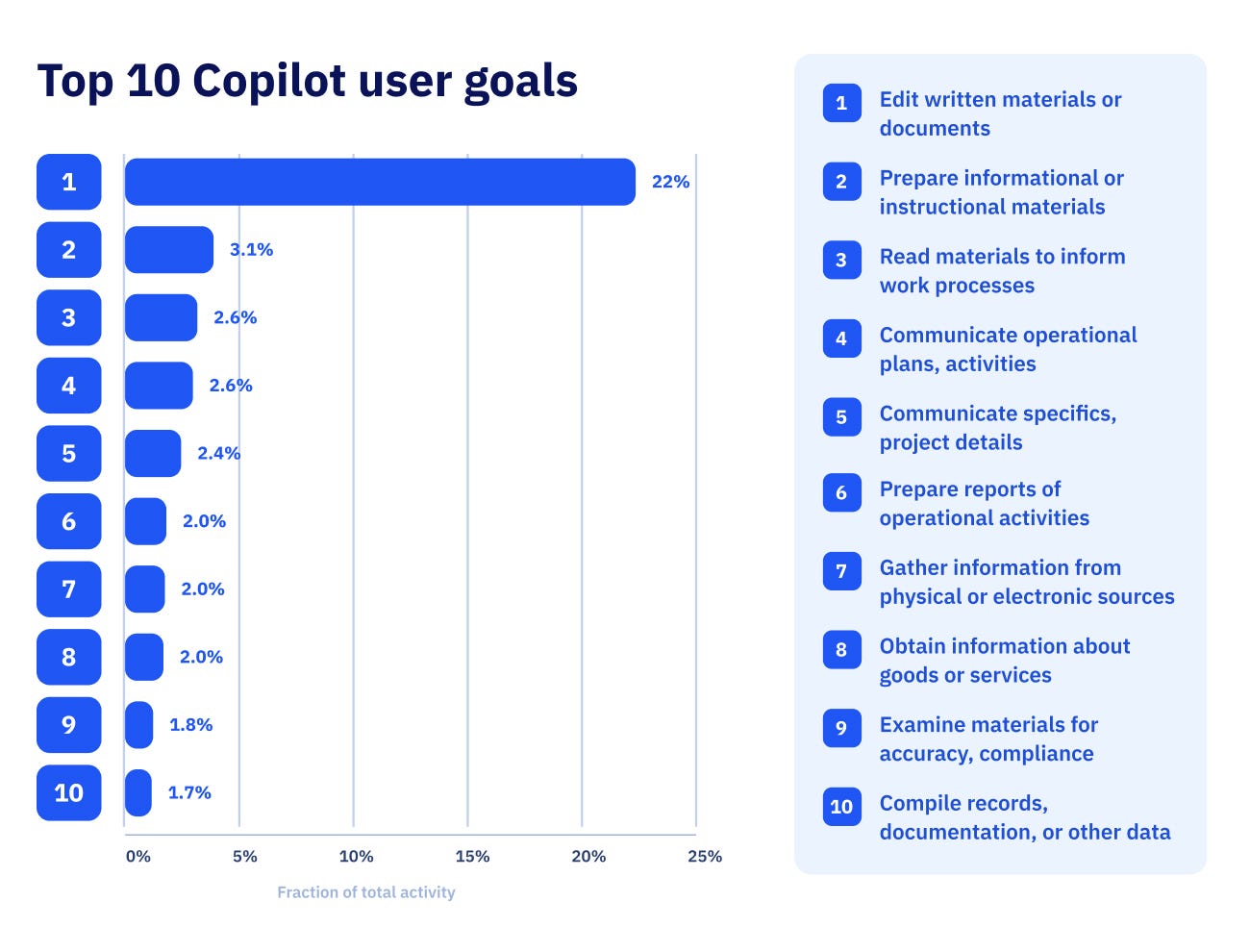
 

A graph showing the top 10 goals people have when using Copilot, with editing written materials or documents being the most common at 22%.

Though limited in scope (it applies to Microsoft Copilot only) the data is clear: professionals are using AI to automate critical communication processes, including how they share operational plans and project details with their colleagues and clients.

Adapted from Figure 8A in AI in the Enterprise: How People Use M365 Copilot Chat (see References section).
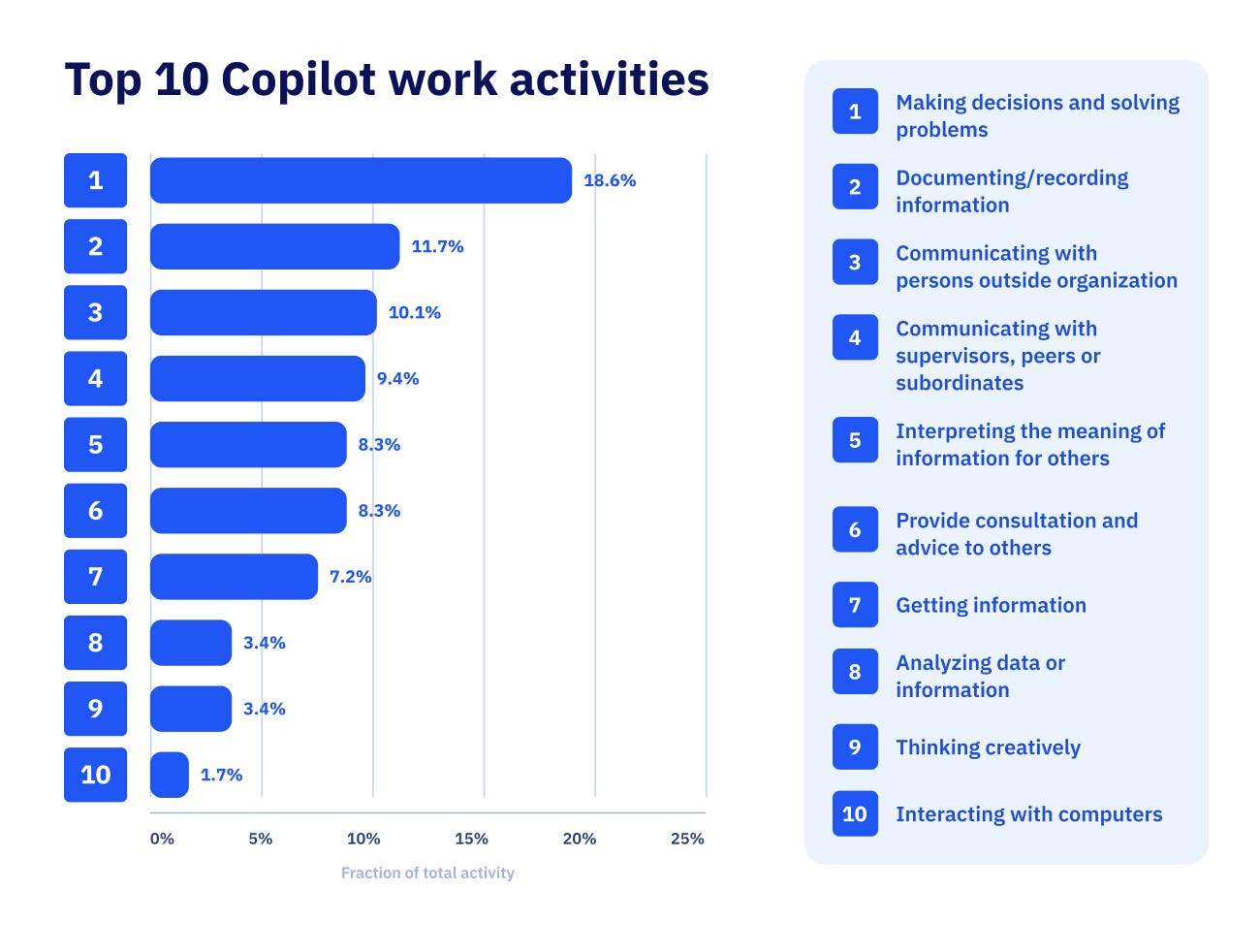
A chart showing that Copilot is used most often for higher-level cognitive and communication tasks, especially decision-making and problem-solving, rather than primarily for technical computer interactions.

Communication with peers, supervisors or partners is among the most frequent Copilot tasks. Documenting, exchanging, and interpreting information, as well as providing advice to others, are now essential AI tasks. But are organizations aware of the implications?

Adapted from Figure 7 in AI in the Enterprise: How People Use M365 Copilot Chat (see References section).

AI usage is being mistaken for communication maturity

Global indexes tell another crucial story: while most professionals are ready to embrace AI, their organizations are not. According to Gallup’s survey on AI, only 1 in 4 US workers reported that their organization had communicated a clear AI plan3.

Leaders may have provided access to LLMs, but they have not defined what good AI-driven communication should look like. In the absence of protocols, they rely on personal responsibility and proactiveness. Not surprisingly, this yields uneven results. Some workers use it to their benefit, others overtrust it, and others reject it altogether. At worst, shadow AI (the use of unauthorized tools) creates serious data privacy risks.


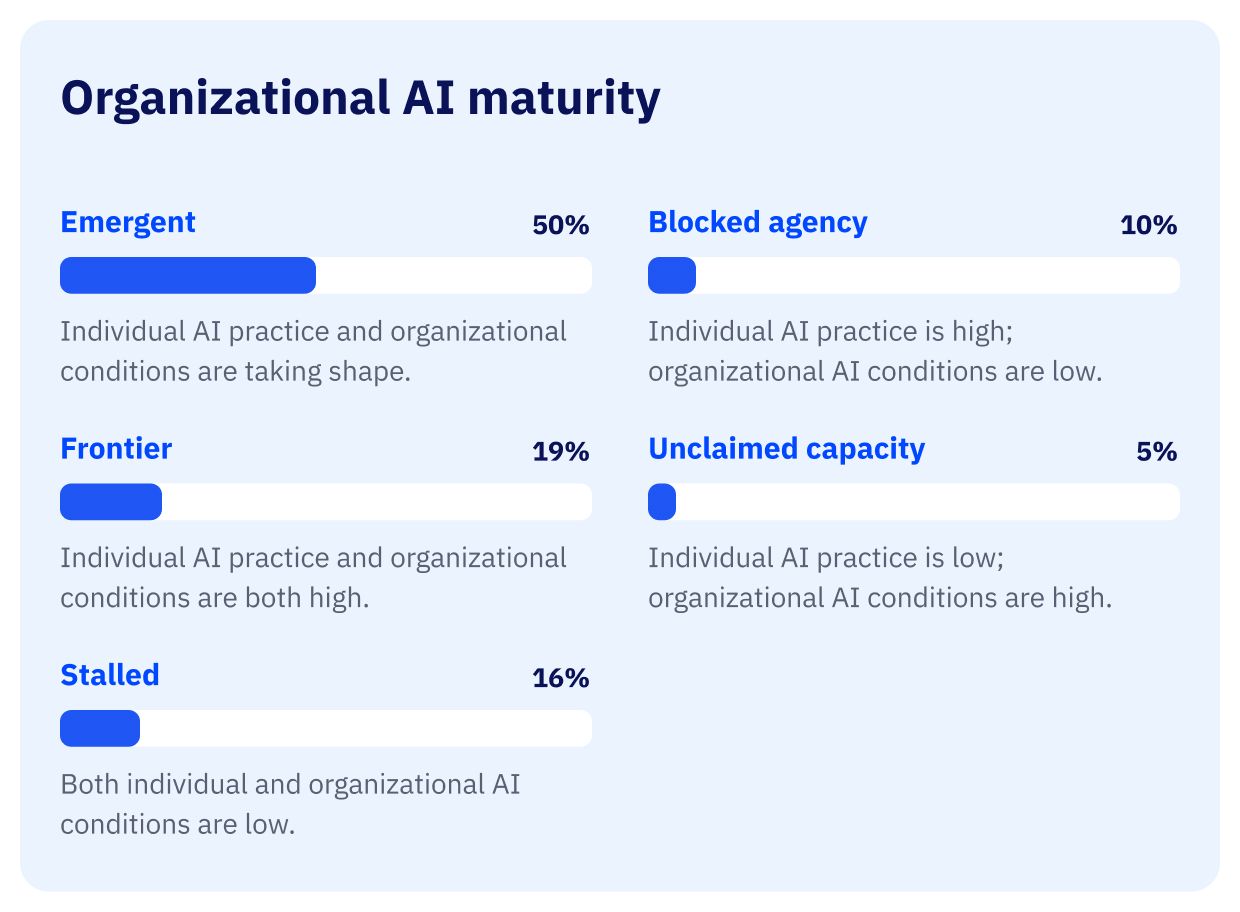
A garph showing five levels of organizational AI maturity, based on how strong individual AI use and organizational support are, with 50% classified as “Emergent.”

Adapted from Microsoft’s 2026 Work Trend Index
(see References section). Almost a third of organizations lack AI maturity, which requires training, workflow redesigns and protocols.

Why are businesses in this position? Because while the AI promise is clear, its risks are often overlooked. Stanford’s 2026 AI Index warns that, “the frameworks needed to govern, evaluate, and understand this technology are falling behind”. As with other technologies, risk assessment lags far behind capability development.

Research shows that almost half of all desk workers in the US receive monthly workslop, AI-generated output that looks good but is inadequate5. This costs organizations millions of dollars annually. But the risk is not just reworks. The real risk is delayed decisions, confused teams, damaged client relationships, compliance exposure, or a loss of confidence in leadership. Organizations should remember: AI can generate communication, but it cannot own the consequences.

Sylvia Tantzen, Head of Strategic Accounts at Berlitz and creator of the Human Code concept, has worked extensively on how organizations can benefit from AI-driven efficiency without sacrificing authenticity, empathy, and trust. In her view, generic, emotionally flat communication could be a serious threat to an organization’s credibility.

What happens when AI goes unchecked?

  • A public servant uses AI to simplify a citizen-facing message and inadvertently removes a critical legal term.
  • A manager loses employee trust by sending sensitive performance feedback that appears to be AI-generated.
  • A CEO sends a partner an AI-generated email that sounds clear but leaves the critical question unanswered.
  • A sales team creates an AI summary of a long project brief and sends the client an inaccurate quote.
  • An HR team sends an AI translation of a protocol that is grammatically correct but culturally inappropriate, as it fails to account for how directness, hierarchy, or disagreement are expressed in the target language.

Most communication failures do not happen because a sentence is grammatically incorrect. They happen because someone misunderstood the intent, missed the context, or failed to recognize how a message would be received. While AI can accelerate communication, it cannot fully anticipate the dynamics of a difficult negotiation, a sensitive employee conversation, or a cross-cultural misunderstanding.

Organizations need to move from tool adoption to communication design

The question is not whether organizations should use AI to communicate. They already do. The real question, as with any technology, is whether they know how to evaluate it critically and to design its use intentionally. What layer of communication are they trying to automate? Is it production, translation, interpretation, or mediation? What workflows, quality standards and guardrails are needed?

Tool-centric approaches will miss the mark. When designing their communication, organizations often reduce it to a few standard rituals and a set of tools. Instead, they should treat communication as the combination of skills, contexts, workflows, and norms that determine how they create meaning internally and externally. For Tantzen, this is also an integral part of company culture.

In the AI era, teams need a system that defines how messages are created, interpreted, validated, shared, and acted on. Writing an email or a sales proposal is no longer the bottleneck. Deciding what is accurate, appropriate, trustworthy, and worth sending has become the harder task. And that is where judgment becomes invaluable. Following a recent Harvard Business Review piece, we could define judgment as “the capacity to act wisely in situations where rules by themselves are insufficient”6.

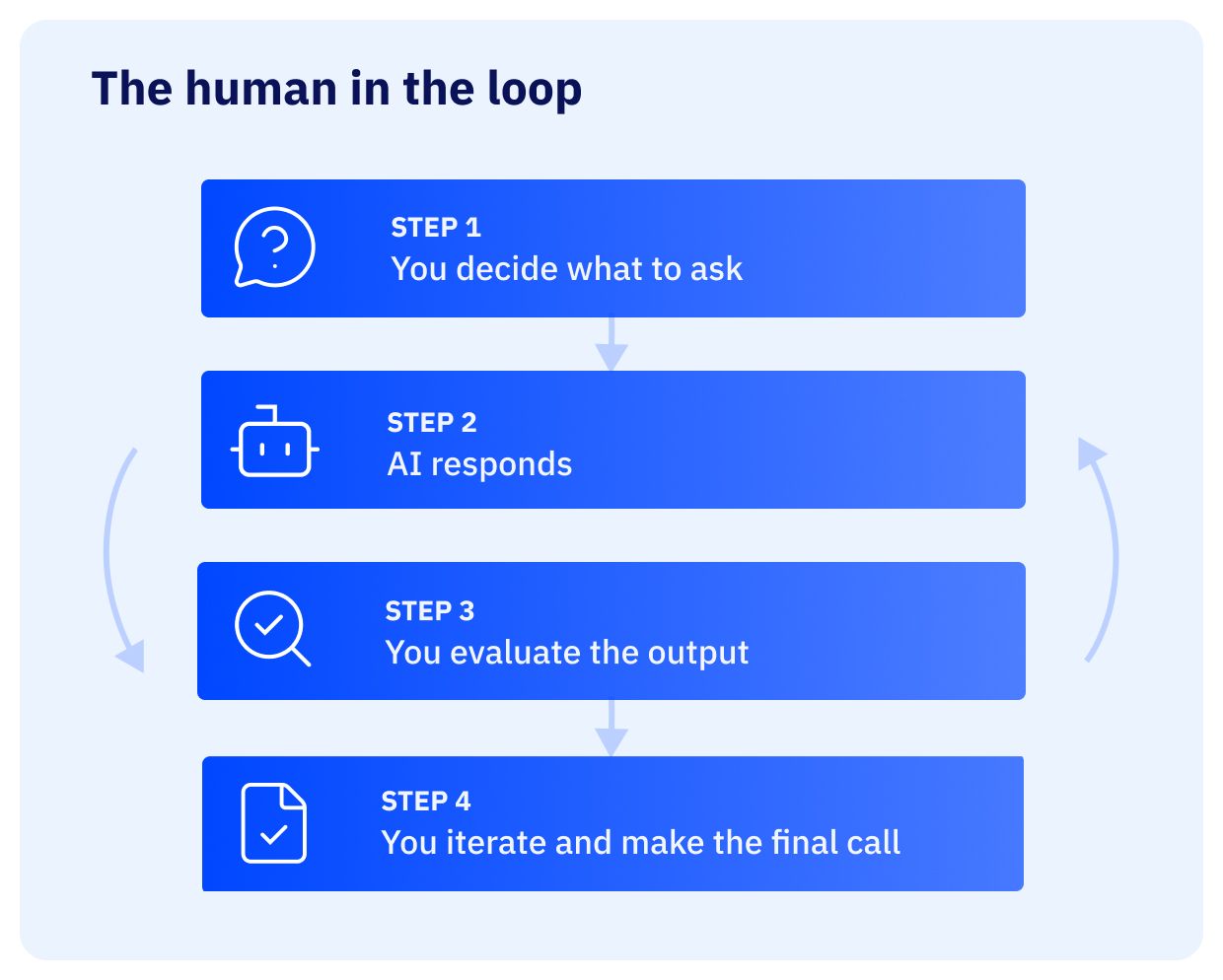
The human-in-the-loop approach has taken center stage in AI-human collaboration, but it leaves a critical question unresolved: how are human approvers trained? What experiences, skills, and instructions help professionals develop judgment? Without deliberate training, AI overreliance could weaken the very capabilities organizations need most: experience, critical thinking, language confidence, and context awareness.


A graph explaining a human-in-the-loop process where you ask AI a question, evaluate its response, and then refine it or make the final decision yourself.

No matter the accuracy of automated work, approvers will always need fluency and cultural intelligence to review AI output. As technology gets better, they too will need to become better writers, editors, mediators; in sum, better communicators. AI makes fluency and context awareness more critical, not less.

Three principles for future-proof organizations

To strengthen their communication culture, organizations need to connect three areas: AI literacy programs; language, culture, and leadership training; and redefined workflows for AI-human collaboration.

1. Distinguish AI fluency from communication fluency, and promote both

Fluency can be defined as the ability to create shared meaning with others in context. It draws on language proficiency as well as broader communication skills, including adaptability, confidence, and cultural intelligence.

AI fluency is different. The 2025 AI Fluency Framework defines it as “the ability to work effectively, efficiently, ethically, and safely within emerging modalities of Human-AI interaction”7. It also describes four core competencies (Delegation, Description, Discernment, and Diligence) and three modalities of AI work (Automation, Augmentation, and Agency).

As theoretical as they may sound, these concepts increase an organization’s maturity and reduce misuse risks. Reports show that most people are learning AI skills outside work and without formal training. Organizations will benefit from changing that.

2. Classify communication moments by risk, context, and consequence

Treating everything as “content” is the fastest way to misuse AI. A meeting summary, a customer apology, a legal notice, a performance review, and a sales proposal require different processes. The same task (writing) carries different implications depending on the setting. Is the message internal or external? Live or asynchronous? Informational or relational? Low-risk or high-stakes?

Organizations should train employees to recognize what each context requires:

  • There are digital, low-risk tasks where AI increases productivity: translating research material for comprehension, creating copy variants, receiving feedback, summarizing one's own ideas, or preparing role-play practice.
  • There are live, relational interactions where spoken fluency is still vital: a manager onboarding a new team member, a sales executive negotiating contract terms with a client, or a CEO responding to employee concerns at a company event. AI may help people prepare, but they still need to listen, adapt, read the room, and respond in real time.
  • And there are high-stakes situations where judgment and review are non-negotiable: public-facing speeches, performance reviews, or crisis communication. In these cases, even first drafts may need to be human-led, with several people validating the final version.

Organizations should also remember that, in some contexts, the perception that a message is AI-generated may itself affect trust, especially when the interaction is sensitive, relational, or high-stakes.

3. Promote communication norms and trained judgment, not just AI policies

Whether implicit or explicit, every organization has communication norms. Teams know who to contact, when to approach them, what channel to use, and how to adapt messages to a goal and a situation. Embedding AI into communication processes is not upending that; it is just making needs clearer and more complex.

Organizations need to provide practical guidance on how to integrate AI, including guardrails for data privacy, tone of voice, and bias prevention. Protocols should answer questions like:

  • How should teams disclose or review AI-assisted work?
  • How will managers coach employees on the quality of AI-assisted messages?
  • Which interactions should remain human-led and which can be automated?
  • How should AI maintain organizational voice, tone, and accountability?
  • What information can be shared with AI, and what should be protected?
  • How should language learning support high-stakes human interaction?

These norms should not sit in a policy document that employees rarely read. They should be embedded in onboarding, training, manager conversations, leadership development, and team workflows. The point is not to slow people down with bureaucracy, but to make processes safer, more useful, and more instructive.

What this means for decision-makers

Communication capability needs to be framed as a cross-functional responsibility.

At the C-level, AI should be seen as a communication layer, not an individual productivity hack. Executives need to redesign communication workflows with AI in mind and set the tone for how the organization balances speed with trust. Flexibility, risk awareness, and a continuous learning mindset will make the difference.

Leaders should treat AI as a copilot, not an autopilot. The goal is not to replace communication, but to free up time for more meaningful conversations,

says Sylvia Tantzen.

L&D teams should offer intentional AI training, alongside language, cultural intelligence, and leadership development. In the European Union, for instance, AI literacy has already become a regulatory requirement. Under Article 4 of the AI Act, companies are obliged “to take measures to ensure a sufficient level of AI literacy of their staff and other persons dealing with the operation and use of AI systems on their behalf”8. Other regions are likely to follow.

Legal teams should help define risk boundaries, while IT should model the infrastructure and answer technical challenges, such as how to protect data and gather audit trails.

Managers need to encourage open discussion about AI use, create the conditions for judgment to develop, and coach teams on best practices. They should help employees ask better questions when using AI to communicate.

  • Can I defend this idea in my own words?
  • Is this message coherent with my voice or my organization’s?
  • Who owns the consequences if this information is wrong?
  • Does this content need human review before it is sent?
  • How can I learn from AI without becoming dependent on it?

Enhancing what is uniquely human

AI has entered the gap between what people need to say and what they have the time, confidence, or fluency to express. The everyday workflow has changed. But in many organizations, the training and shared norms have not.

In an immature communication culture, AI can multiply noise, weaken accountability, and strain shared understanding. In a mature one, it can help people convey ideas with greater speed, clarity, and confidence.

Leaders need to build systems that help their teams understand how messages are created, reviewed, shared, trusted, and owned. To succeed, they will need a strategic view of communication and a commitment to raising human capabilities.

Every day, people explain ideas, persuade stakeholders, resolve misunderstandings, negotiate outcomes, and build trust through communication. AI can support those moments, but it cannot replace them. Organizations that thrive will be the ones that use technology to enhance human communication, not bypass it.

Contributors

  • Sylvia Tantzen is Head of Strategic Accounts at Berlitz and creator of the Human Code concept. With more than 20 years of experience in AI, sales, and leadership, she focuses on the intersection of technology, communication, and human connection. Her work explores how organizations can combine AI-driven efficiency with empathy, trust and authentic leadership.
  • Ursula Marinos studied languages, business, and cultural studies. For 29 years, she has held diverse roles at Berlitz, ranging from B2B sales and project management to District Director and now Inhouse Academy Director. Additionally, she has worked as a trainer, specializing in communication, intercultural management, sales, and leadership.

References