Workplace relationships were already at risk

For a long time, the pressure to produce often pushed connection into the background. Lately, remote work, distributed teams, and AI have added extra challenges. They require managers to be more intentional in how they build and protect company culture.

The pandemic is a key precedent. It was when many organizations learned how to create space for conversations around connection. They understood that employee wellbeing and engagement depend on management, not work modality.

Global surveys help us understand how people feel about their jobs and AI today. We know that, significantly, only 20% of workers worldwide feel engaged, and that 22% feel lonely1. There is also a recent Workday index I found enlightening. 43% of surveyed professionals cited reduced human-to-human interaction as their top AI concern. And 33% reported that they rarely or never have non-transactional conversations with colleagues2.

To me, this speaks volumes. Workers crave connection. They understand that AI transforms how they experience work, how they interact with colleagues and customers, and how engaged they feel. Organizations must pay attention.

How lack of connection hurts organizations

Managers should remember that human connection is not just something their teams wish for, but also what makes businesses innovate and thrive.

There is strong data on this. Gallup calculated that lack of engagement cost the global economy 10 trillion USD in 20253. Sunny estimates that a lonely employee can cost a company 13,309 USD a year4. Many of us who have led teams are not surprised by these figures. We have witnessed first-hand that wellbeing and performance are inseparable.

I see motivation and belonging as the foundation. When they are seriously lacking, quiet quitting and absenteeism often become an issue.

More subtle, but just as critical, are the effects on collaboration and informal problem-solving. These two are invaluable, and they can take many forms. Emailing a colleague to ask for support. Casually going up to their desk to clarify something. Even running into them during lunch break and getting encouragement, context, or a simple reminder.

When people collaborate well, they do more than split tasks. They exchange perspectives, challenge assumptions, build on each other’s ideas, and generate better decisions and more original thinking. If leaders strive for excellence, they should protect the conditions that make it happen.

Another issue I’ve seen repeatedly is weak knowledge transfer. Mentorship, coaching, and sponsorship are all essential to personal and professional growth. Not having these kinds of relationships can be a sign of disconnected teams.

Lastly, there is trust and shared context. When teams are informed about decisions, but not about who took them and why, alignment suffers. It’s natural: we embrace something when we know who we are helping, how and why.

I have also seen this harm sales and customer relations. As a startup mentor, I noticed that founders often believed their biggest challenge was building the right technology. In reality, the harder challenge was usually helping customers embrace a new way of working and inspiring trust in the solution.

AI gives leaders a choice

The good news is that tools don’t create culture. Leadership around them does. According to Deloitte, 42% of workers say their organization rarely evaluates AI’s impact on people5. If you oversee a team, you can show them you care.


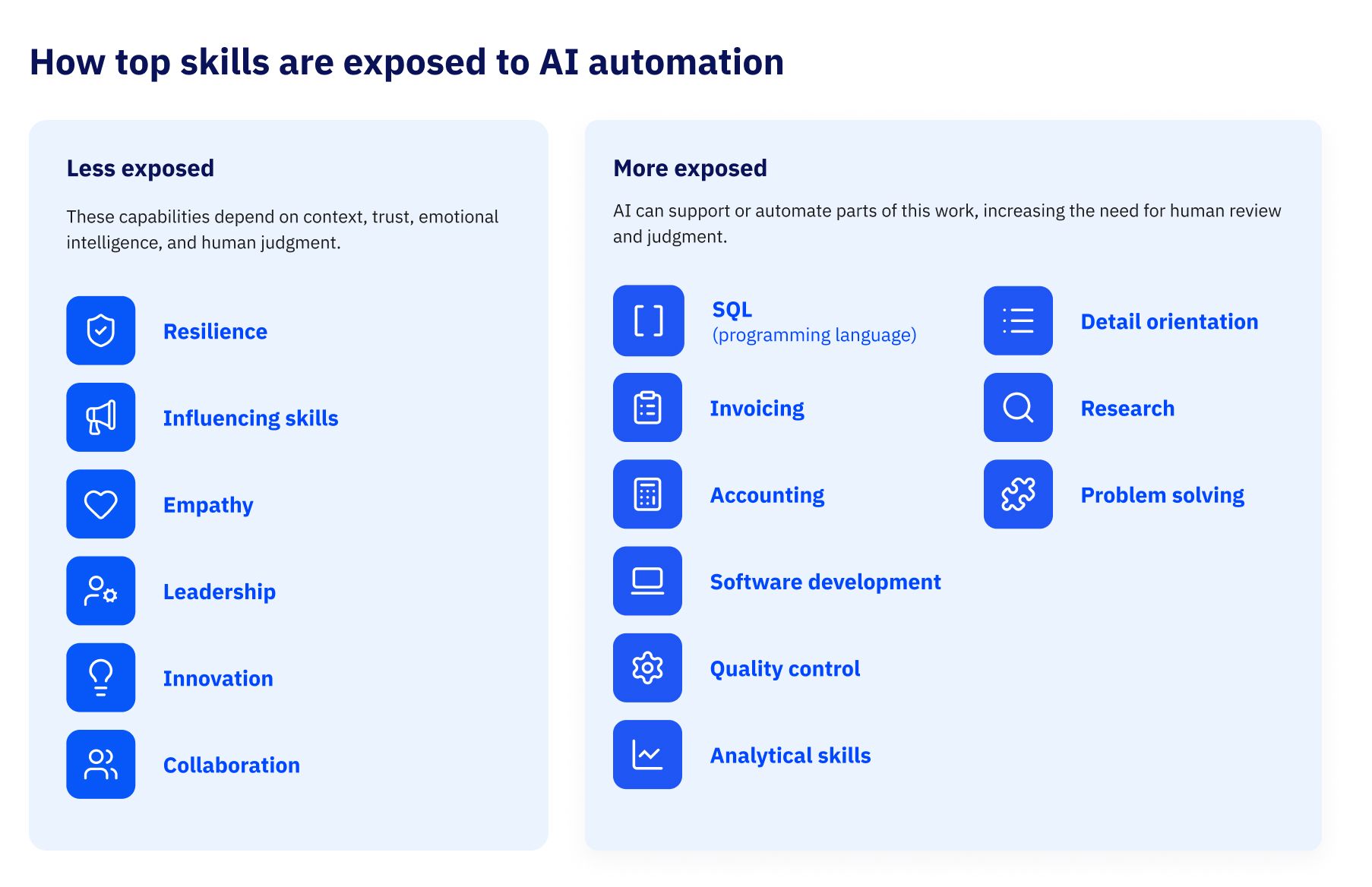
Graph on skill automation

We know workers increasingly rely on AI for support, mentorship, or collaboration. In some cases, it may be because they are prioritizing speed. But have they been encouraged to fulfill those needs through their colleagues and higher-ups?

That, to me, is what distinguishes successful leaders. They understand that AI adoption and satisfaction are shaped by the culture and role models they set. And they define how AI should support better work while strengthening company culture, not just efficiency.

Today, in my role at Berlitz, I see this every day. As AI makes knowledge increasingly accessible, the ultimate differentiator is no longer information. It is the ability to communicate effectively, collaborate across cultures, build trust, and maintain meaningful relationships.

This is what I call the Human Code: the human capabilities that become more valuable as AI becomes more powerful. They determine whether technology improves collaboration and quality or simply accelerates isolated work.

  • Trust gives people confidence in the intention and accountability behind a decision.
  • Judgment turns AI-generated options into choices that are appropriate, ethical, and useful in context.
  • Empathy helps leaders understand what remains unspoken: hesitation, fear, frustration, motivation, or doubt.
  • Curiosity pushes teams to ask better questions, challenge assumptions, and keep a continual learning mindset.
  • Courage allows managers to take a stance, give honest feedback, and protect human priorities when efficiency becomes the default.
  • Human-to-human communication creates meaning, clarity, and alignment, even when AI makes messages faster.
  • Cultural understanding helps us interpret context, tone, hierarchy, expectations, and trust in a globalized work environment.

These capabilities are not the opposite of AI. They are what allows organizations to benefit from it. A leader can use an LLM or a virtual coaching agent to prepare a high-stakes conversation, but it is empathy and active listening that will determine the outcome.

I recently came across the German term Empathieberufe, which roughly translates as “empathy-driven professions” or “empathy-based roles”. The forecast is that, as AI takes over more analytical and repetitive tasks, human work will shift towards areas where interpersonal connection is essential: mentoring, coaching, guiding, listening, building trust, etc. In that sense, empathy is not just a personal quality. It may be one of the most valuable professional capabilities in the AI era.

How leaders can bring teams together

We know that the benefits of AI are not without risk, but slowing down adoption is not the answer. Neither is romanticizing the past. The real opportunity is to be more intentional about your priorities. Here are some initiatives that have proven useful in my experience:

Protect time for relationship-building, not just task execution

Time freed by AI should not become extra output pressure. To promote excellence and growth, reserve that time for mentorship, team-building rituals, creative explorations, customer conversations, and meaningful leadership moments.

Identify internal influencers and successful rituals

Strong cultures are often shaped by specific people and routines. Maybe it is a weekly team check-in, a project retrospective, a mentoring circle, a shared learning session, or an informal Friday conversation. Identify where connection is already happening naturally in your organization and build from there. Not only will it save you time and effort; it will also be received more naturally.

Train teams in communication, feedback, and trust-building

Making shared norms explicit helps everyone understand how they should behave. This includes communication. Train teams on how and when to reach out, what good feedback looks like, how to handle difficult conversations, and why accountability is crucial.

I have seen this time and time again: professionals leverage AI to develop their proposals, but it is their credibility and communication skills that often make them succeed, whether that means winning a customer or getting C-level buy-in.

Make communication quality part of AI readiness

Let your team know that AI is not just about tools and speed. Provide them with AI literacy so they know how (and how not) to rely on it for communication. If you oversee operations, create an environment where people can openly discuss how they use AI and how they can protect valuable interactions.

In global teams, this becomes even more important. When managers across Europe and Asia collaborate, for instance, success depends on more than a shared language. AI can translate, summarize, and produce messages for them, but cultural intelligence will determine success.

Build rituals that transfer context, not just information

Throughout my career, I've seen that even the best transformation strategies failed when people didn't understand the "why" behind the change. The technology was ready, but without trust, communication, and engagement, adoption never followed.

Whether you are restructuring departments, redefining procedures or implementing new tools, make sure your teams understand the bigger picture and why their support matters.

Measure connection as part of organizational health

What leaders measure signals what they value. If you are measuring productivity, I encourage you to also track engagement, psychological safety, collaboration, communication effectiveness, knowledge-sharing, and customer trust.

This can be done through pulse surveys, team retrospectives, manager check-ins, collaboration reviews, and customer feedback. Over time, these signals will help you understand whether company culture is protecting wellbeing, innovation, and growth.

Engaged teams will always make the difference

AI will continue to reshape how people work, learn, communicate, and make decisions. That is not something to fear. It is, however, something to lead with intention and courage.

No matter how much technology improves, human connection will remain the foundation of trust, accountability, collaboration, and long-term business success. AI can amplify our capabilities, but it cannot replace what makes genuine relationships possible. Empathy is at the heart of that.

I see this moment as an exciting opportunity. Not to become less human because technology is more powerful, but to become more aware of and more adept at what only humans can contribute.

The future will belong to organizations that use AI wisely, communicate clearly, build trust, and protect the bonds that help people do meaningful work together. The more powerful technology becomes, the more intentionally we need to protect and develop what makes us human.