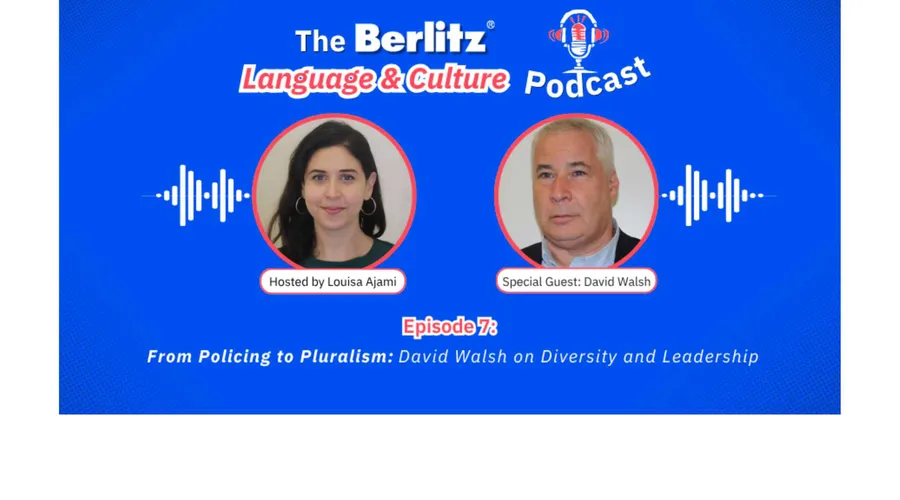
From Policing to Pluralism: David Walsh on Diversity and Leadership
Author:
Berlitz
What does it take to build truly inclusive, high-performing teams in today's global workplace?
In this episode of the Berlitz Language and Culture Podcast, host Louisa Ajami speaks with intercultural expert, author, and Open Minds Consulting Group co-founder David Walsh. Drawing on decades of experience in diversity, inclusion, policing, and intercultural leadership, David explores the role of open-minded leadership, cultural intelligence, psychological safety, and deep listening in creating stronger multicultural teams.
Discover practical insights on overcoming workplace divisions, fostering creativity, managing cultural differences, and understanding why "every contact leaves a trace."
Transcription Episode 7
Louisa Ajami: Welcome to the Berlitz language and culture Podcast, where each episode, we speak with different intercultural experts about communicating, collaborating and optimizing the workplace in today's multicultural, globalized business world, today, we have the pleasure of speaking with interculturalist David Walsh. David has worked for decades on cross cultural training, employee learning and managing differences. He has a range of professional experience, starting as a police officer and establishing the Garda police forces, racial, intercultural and diversity office in the Republic of Ireland. He's also the co founder of Open Minds Consulting Group and author of policing pluralism and cultivating pluralism by oak tree press, among many other published works, among many other published works.
David Walsh: How are you? Louisa, thank you so much for having me on the call. Delighted to be here.
Louisa Ajami: I'm great. I'm very happy to have you. Thank you so much for taking the time to join us today.
David Walsh: You're welcome.
Louisa Ajami: So David, you've worked with a lot of organizations and teams across industries and world regions when working with cross cultural teams, what's the best way that managers can bring out their team members creativity and dynamism?
David Walsh: Yeah, Louise, I, as you said in the introduction, I've been so incredibly lucky. The reason I ended up on this work in the first place was that I was an officer in the Irish police many years ago, and one day, I was coming back from lunch, and I happened to see somebody who was visibly distinct in the street in Ireland. And I know that, you know, for an American, that probably sounds not so unusual, but here, that person really stood out for me that day, because I suppose at the time, the stereotype of Ireland was, you know, quite straight, Catholic and homogeneous. We just did not see anything like the visible diversity that we see today. And that's why, you know, the man that I saw kind of stood out for me. And it took me on a journey that, you know, began 25 - 30 years ago, and takes us to today. Shortly after I saw that man on the street, I ended up back in Trinity College, Dublin, here doing some research, um, research on changing Ireland and what was beginning to happen. And, you know, after I had completed it, was an M fail, and after I had completed it, and gone back to the police and and said, Look, you better set up a unit. This is coming, you know, immigration is going to hit Ireland in a way that, you know, we just have never seen before. And as an island nation, you know, we were kind of, I suppose, immune to, you know, waves of immigration that might have seen in other parts of Europe. We weren't a colonizing nation. We'd never gone anywhere so, so we'd no real expectation that people were going to arrive in the numbers that they did. But, you know, that's exactly what happened. You know, over the next 1015, 20 years, we just began to see a huge amount of people arrive to Ireland from all over the world for various reasons. And I think today, 15 or 20% of the population, you know, are probably people who have come from various or related to people who've come from different parts of the world. So yeah, it began the journey for me as it began initially in the police and then ended up in lots of organizations when I created open minds. And I've been so lucky, over the past 20 years, I've been in Istanbul and Cairo in Vietnam and India and Africa, in the States, and all over Europe, done this kind of work with, you know, some of the world's kind of leading global organizations. So I've been incredibly lucky to answer your question for me, the leaders you know, who are best, or have been the most effective at encouraging creativity and dynamism? You know, those two words when you think about them, they're qualities of a mind that is not stressed, or is not, you know, or is free of drama. So for me, the leaders who have been greatest or most impactful in that area are the ones who kind of appreciate that. You know, people moving from one part of the world to the other are working across cultural teams. It is a stressful time for them. It is difficult. You know, the work alone. Never mind whatever else is going on in the background. So the ones, for me, who've been best able to appreciate that, you know, they are qualities, as I said, of an open mind, and the ones who work to create spaces in. Workplaces for people to deal with the drama and to deal with some of the stresses that people might bring. They're the ones who've been most effective for me.
Louisa Ajami: Now I'm glad that you said you mentioned having an open mind, because in our cultural orientations approach the first step, or the first criterion for becoming interculturally adept, is having an open mind?
David Walsh: Absolutely, yeah, yeah, yeah.
Louisa Ajami: Now not everyone has an open mind, and sometimes it's a process for people to get there, and for team leaders, the idea of having to wrangle people, of having to manage people who might be at different stages of open mindedness, or who might have different ideas about what it takes to work on multicultural teams that might be a big challenge for leaders. What is there, or is there a strategy for overcoming divisions on teams, outright? Divisions?
David Walsh: Yeah, again for me, you know, I have seen many, many divisions for all kinds of reasons. But ultimately, divisions, you know, come from misalignment. Come from the perceptions that people are holding about, you know, other people are about processes or about objectives or whatever it would be, and usually it's, it's around misalignment. And I often say to people, you know, managers want to be working in companies. And often say, can you imagine being on an aircraft that takes off and gets to 10,000 feet, and your hope was that you were going to fly to London or to New York or whatever. But if the pilot says to the co pilot, at 10,000 feet, you know, which way is New York anyway, or which way is London, anyway. And the co pilot looks over to the captain and says, Well, I think it's that way. And the captain said, I thought it was this way. So why don't we go in the middle and see how we get on? They're completely misaligned. So, you know, on journeys like that, we make sure that before we ever, you know, get in the plane, that people are aligned. And it's no different in business. It's about lack of alignment. So for me, you know, some of those divisions that we encounter come from lack of alignment. And again, to go back to your last question, leaders who can recognize that misalignment and can recognize the mindsets that caused that misalignment are the ones who are most effective in terms of creating cross cultural teams or intercultural teams that work at their best. So for me to answer that question, divisions, you know, come from misalignment, which come from perceptions, and people from this thinking that creates their realities. And those are the kind of the biggest barriers that I've come across on teams. Sometimes they're related to, you know, not just the task, you know, but it's the process of, maybe for expats moving from one part of the world to the other, the family issues, the social issues, the background issues, settling onto new teams, moving home, all of that stuff with courses at play.
Louisa Ajami: Now, as someone who's done this for years, multicultural training, diversity training, what are or how can we approach cultural training with those who may be skeptical of it or who may believe that they're being forced to change the way that they work?
David Walsh: You know, Louise, it's a great question, um, and honestly, my experience over all the years that I have been doing this work is that one of the biggest challenges and probably the greatest opportunities when it comes to diversity and inclusion, and we know what's happening in our world at the moment, as we as we create this podcast, one of the greatest barriers that I have seen is that for many people, Not always, but for a lot of people, they perceive diversity to be about the other for some reason. You know, we hypothetize, hypothesize it, or we understand that as being about the other, and for that reason. And you know, when we are asked or invited, or whatever directed to go on, you know, a program that looks at differences, unconsciously, we're kind of coming thinking, Well, that's about them, whoever them happened to be. And the second thing is that for me, you know, no matter what we human beings do, at some level, there has to be something in it for us. And if I perceive that diversity is about them, and I don't see anything in it for me, then it's very hard to generate energy to participate fully. So for me, the companies, the organizations, the managers who have been most effective in this area are the ones who have managed to make diversity personal. In other words, that the people showing up, the skepticism comes, I believe, from not believing it's about me, but when I'm helped to realize now actually it's the person in the mirror. That's who we're talking about first of all. And if you can see it in that way, then there's a great there's a greater chance that I'm going to try and understand Louisa or whoever else you know I'm working with or dealing with at that moment. So for me, the skepticism comes from these perceptions that it's not about me. I'm having to do this for the other so it's trying to get away from this idea of. Honest for me is key, trying to make it personal as often as we can show me what's in it. For me, what's the benefit for me to show up here today? You know, whether it's diversity training or inclusion training or intercultural training, what's the benefit for me? Another thing that's crucial is that I work with a friend of mine who is an accountant, but he runs the starter on business programs for a lot of clients here, one of the things I do a piece on this program, but one of the things I often say to people is, people start a business for all kinds of reasons, but when you say to them, what problem does your business solve? A lot of people haven't thought about it in that way. They set up a business doing something because they're good at but they don't normally think, what problem am I solving? Because the better you can solve a problem for somebody else, the more effective you're going to be, and the more they launch it, and the more they're going to pay you. And that's exactly the same here, that when it comes to, you know, Intercultural Programs or diversity problems. What problems are we helping to solve for people who might be skeptical? And I think if we can come at it in that way and say, showing up here today, here's the problems that will help you to head off, here's the problems it will help you to solve. And the other thing for me that's crucially, crucially, crucially important is to recognize that even when somebody is skeptical, there's always a positive intent. They're doing it for a reason. And if you can stand behind, you know, go behind the behavior that you're witnessing and look for the positive intent. We had an experience in my home here a long time ago where we had some foster children staying here, and at one stage we thought one of them, it looked like, you know, some money had been taken from our home, and I remember getting kind of angry and frustrated and start to breach of trust and whatever. But one of the social workers who was working with the young lad said to me, you know, it's perfectly normal to feel the way you're feeling if you think somebody has stolen from your done something, you know, to make you feel something that would make you feel the way you're feeling. But she said, can I give you another suggestion? And I said, please go ahead. And she said, you know, foster kids, when they're getting moved from one house to another, it can be a hugely difficult time for them, and sometimes they'll do an act to break the relationship so that they can go, you can let them go, and they can go feeling easier. And for me, it was a powerful, powerful, powerful insight, and it's one I've never forgotten, and I'd often use it with managers to say, always go behind the behavior and look for the positive intent. And when you see the positive intent, it shifts your whole perspective. So to answer that question, you know, when people are forced or skeptical, try and find the positive intent. What is it that has them there and try to address that.
Louisa Ajami: Now, you spoke a little bit early about the impact of drama and stress on work and how managers can work with that. What element does stress play in inhibiting teams and individuals progress in the workplace?
David Walsh: I again, you know, I'm human, the same as every other 8 billion of us on the face of this earth. And I, again, would often say to people in programs, where is the trigger any human being for stress? In other words, you know, how do I fire it off if I want, you know, to somebody to get into a stress state? And inevitably, the answer is, it's our thinking. We run a thought in our head of the you know that this is going to happen, or that's going to happen, or, you know, I call it the fourth, the four in the morning feeling, you know when you wake up from a dream and your heart is racing, and why? Because you've been dreaming. You've been running pictures of, you know what you think is going to happen. What does it do? It fires off adrenaline. You have a biological reaction, and, you know, your heart goes into overdrive, and you get stressed, and you can't get back to sleep for a while. And it's fine, because it's part of who we are. It's part of the human makeup that, you know, we have this mechanism, this fight or flight mechanism. But a friend of mine in the States, Shannon Murphy Robinson, wrote a fantastic book that I highly recommend to your listeners, some years ago about science of inclusion and being able to recognize that, you know, in any moment human beings, we are thinkers. From the moment we take our first breath till we take our last one, we are constantly running thoughts, and the thoughts are shaping our reality. And you know, if we're running thoughts about, is my family safe? Am I going to be able to find accommodation? Am I going to be able to do the work, right? Am I going to be able to manage this team? Am I going to be, you know, I can think of couple of people I worked with at various stages. One of them was a very senior Indian manager who would come here. He was a medical doctor, but he was managing a team. And one day I was coaching him, and one he said to me, he said, Dave, My blood is boiling. Now you can imagine, you know, and your listeners, can imagine the state you have to be in for your blood to be boiling. You're in a fairly emotional state. And I said, What's the problem? And he said to me, I'm telling my team, I want them to do this and this and this. And he's giving directions, and he said they're pushing back. So what was really happened was he had come from high power distance, India, and he was used to, you know, kind of telling people what to do and how to do it. He had arrived in low power distance, Ireland, where people, you know, they weren't pushing back at all. They were trying to be as helpful as they could. They were trying to give them better ideas, other ways to do it. But for him, through his lens, he saw this as kind of pushback. So what does it do? It creates stress. He's in this, you know, limbic brain state that Shannon talks about in our book, and while he's there, he can't be creative. So going back to your first question earlier on, you know, when you said to me about, you know, how do we release dynamism? You know, if people are in that stress state, they're never going to do that. So our job really is to help them to get to this prefrontal cortex state, or this part of our mind, where we're creative, where we're loving, where we're responsible, where, you know, we come up with ideas. And that's really a manager's job is to help people to be in those states. And it's an art, and it's, you know, it takes a lot of skills, and it's an art, but, but to get people to there, for me, is really key, and to be able to recognize that a lot of stress, in fact, all stress, comes from thinking, and to recognize that it's the thinking that's causing the problem. And if we can get there, I would be very driven, very mindful of the work of a company called Insight principles in the States, Ken Manning and Robin sharbert, again, who would have looked at this whole idea of, you know, invisible power and the power of the mind to influence business. So for me, that's where that, you know, in the all the years I've been doing this work, particularly in the intercultural area, a lot of stress, as I said, comes back to how people are feeling in any moment they're living in that feeling of thinking. So, you know, great managers help people to move from those feelings to recognize what's causing it. In our case, practically, as I said, it's the stuff, it's the long journey. It's leaving my family behind. It's moving to this new environment. It's how do I settle? How do I speak the language? How do I that? So for me, those are the real opportunities, right?
Louisa Ajami: I wanted to end with a maxim that you've brought from your time on the police force, every contact leaves a trace. How do you incorporate that expression into your work in the intercultural space?
David Walsh: It's an expression I love, and it was one of the ones we learned first, you know, many years ago, when I began to study criminology. And basically what it means is that, you know, no matter how good somebody is, you know, if they break into your home, they're going to leave some kind of a trace, or if they, you know, do some kind of they're going to leave some kind of a trace, and a good enough investigator will always find that trace, whether it's DNA or fingerprints or whatever. But for me, it was a really powerful metaphor or analogy for the work that we do in the intercultural space. Every time we contact with another human being, we leave a trace. There's a fantastic talk on YouTube. I'll send you the link for further if you want to put it up with this podcast afterwards, by a lady called Heidi Schleifer. She's a family therapist, but Heidi has this contention that the space between two parents is the playground of the child. In other words, you know, that's a sacred space, then the child grows a breach. If it's not, then the child grows up with whatever issues might be there. And for me, our workplaces are no different. The Space Between Us is a really crucial space, um, and the more we think as we enter that space, you know, whether it's one on one or one on a team, or whatever, as we go into that you use the word consciousness a few minutes ago, when we go into that space with a heightened sense of consciousness about the people I'm dealing with. In other words, I go in and I try to be as drama free as I possibly can be, and when I'm there, then I'm in a much better position to encourage loyalty, growth, motivation. You know, any of the terms that it is we look for in teams are in a much better position to make that happen. So the more we can help people to come with an open mind and to realize that every time you interact with another human being, you're leaving a trace, and to think in a positive, proactive way. What trace could I be leaving? What else would I need to do to leave a better trace? So for me, that's where that comes from, that idea of, you know, thinking about the trace that we leave, I've been able to look back and say, you know, I left a positive trace there. And that's the goal. So for me, that's the goal. And very often, again, you know, it means, you know, as a manager, as a leader, you know, as a parent, whatever you know being grounded. The other thing is that, you know, we have got to show up in service. We've got to be present. I have an uncle who's been treated for cancer at the moment, and I brought him to see a doctor not so long ago, and it was the day that they were going to give him the diagnosis. And we sat for six, seven. In eight minutes, you know, while the doctor was busy on his computer, inputting whatever he was inputting, and my uncle kind of turned to me under his breath and said, You know, I thought he would have done this before we came in. And I said, Yeah, so did I. And the point I'm making was the doctor was doing what the doctor had to do, but he wasn't present in that moment for my uncle. Now he did afterwards, you know, he did exactly what he needed to do, and he explained everything. But I'm saying to you, that was a moment where he could have been really present and dealt with us first, and then did so great leaders for me are the people who show up present. They're here in the moment. Okay, they come with that open mind. And so for me, the contact, you know, when I say that experience leaves a trace for us. Now, great. It's one that we can use on this, you know, to help people to realize that the power of presence and the importance of presence, but that's really what I'm talking about, that idea of being in service to the people on your team, or the expat that you're dealing with, or whoever it happens to be in the intercultural space. And then the other thing that's crucial is understanding the needs, you know, and the only way we're ever going to understand people's needs is to listen, listen, listen. I spent two days recently on a program, a deep listening program, literally two days just learning how to deep listen. And you know, for me again, great leaders are people who can listen to really understand. And the other thing then is to act, to do something.
Louisa Ajami: Thank you so much, David for joining us, and thank you for just sharing, even just some of your wide ranging expertise. It was wonderful to have you here and to share your insights and your experiences with our audience.
David Walsh: Hey, Louisa, it was my pleasure. And you know what? I hope this podcast leaves a trace for as many people as it possibly can.
Louisa Ajami: We hope that too. David, thank you so much, and tune in for more insights around working across and within cultures with the Berlitz language and culture podcast.
.jpg?auto=webp&format=pjpg&quality=80&width=800&height=800&fit=crop&crop=800:600,smart)