Collaboration Across Borders: Lessons from France and the US [Podcast]
Author:
Berlitz
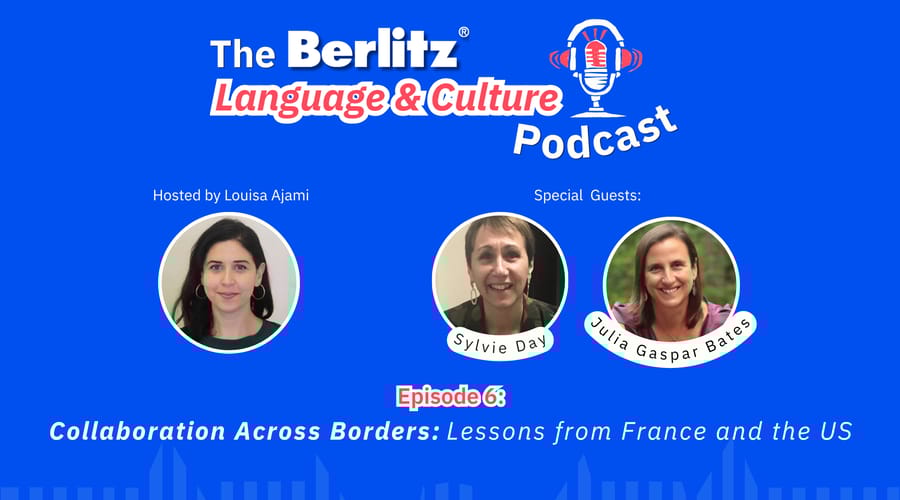
In Episode 6 of the Berlitz Language & Culture Podcast, host Louisa Ajami sits down with intercultural experts Julia Gaspar Bates and Sylvie Day to explore how French and American professionals can collaborate effectively across borders.
Julia and Sylvie share stories from their joint book project, highlighting the nuances of teamwork, communication styles, and cultural norms.
Whether you work in multicultural teams, lead international projects, or are simply curious about cultural competence, this episode offers practical insights and real-world examples for improving collaboration across borders.
Transcription Episode 6
Louisa Ajami: Hello and welcome to the Berlitz culture Podcast, where each episode, we speak with different intercultural experts about communicating, collaborating and innovating in our diverse and globalized business world today, we have the pleasure of speaking with interculturalists, Julia Gaspar Bates and Sylvie Day. Sylvie Day has been an intercultural consultant for 20 years, facilitating programs on multicultural team building, global leadership, presentation skills, cultural awareness and the challenges of working in virtual teams, as well as preparing expatriates and their families for overseas assignments including France, the United States and the United Arab Emirates.
Julia Gaspar Bates is president of intercultural alliances LLC, and has been a senior consultant with Berlitz cross cultural for over 20 years. Julia has trained 1000s of leaders and teams globally on how to build cross cultural competence and collaborative and how to collaborate effectively across cultures. Julia and Sylvie are joining us from Paris, France, where they are currently working on a book about us and French Business Cultures, set to be released in 2026.
And the book explores navigating, navigating cultural differences between French and Americans at work. So welcome Sylvia and Julia.
Julia and Sylvie, together:: Thank you. Merci.
Louisa Ajami: As interculturalists, you both have extensive experience working with multicultural teams, and now that you're working together on a joint project, both face to face as you are now and also virtually, how have you put your understanding of each other's cultures and as individuals into play?
Julia Gaspar: Yeah, great. Thanks for asking that question. I think that so many different ways, you know, we spend so much of our life working on the theoretical where we're preparing others, where we've now really embodied this experience for the first time. And just, you know, I'm just thinking of one example that really sticks to mind for me, that I've actually shared in some of my workshops with French and Americans working together recently has been about a year or so ago. We were sitting at my kitchen table in Washington, DC, and we both had our computers opened, and Sylvie had written this wonderful case study for one of our chapters. And and I said, Well, why don't I write a debrief for this case study? And you look through, I had about 150 pages of notes from interviews that I had conducted, and said, Why don't you try to find some good quotations that we can use in the book? And she looked at me, and she said, but we're not collaborating. And I said, Well, yes, we are. I said, we're kind of dividing and conquering, but we're, you know, we're still collaborating, but, you know, we've got limited time, because we only see each other three or four times a year in person. And I said, Why don't we, you know, sort of do this to maximize the time. And I think that what we realized was that our notion of team building and teamwork was really that I was coming at it more from a very individualistic perspective of keeping working in a silo, so kind of divide and conquer, where each of us do parts and we discuss it, whereas for Sylvie, it was very much collaborative, like we go through each and every piece, we write it together, we really discuss each thing. So that was really eye opening for me, and even though I'm very familiar with French and American teamwork.
Sylvie Day: But it's very interesting because, you know, we know that we should have probably talked about, how do we want to work together? Because we get along very well. It's easy, but we never establish rules about what we do is multicultural team, where we we say to the multicultural team, you need to, you know, to to share. How do you want to work? How do you want to solve conflict? How do you want to communicate? How do you want to work as a team? And we just jump in, right? And of course, because we know both culture, it's true, we kind of adapt to each other until it's true that we experience, you know, that that challenge you just, you just described. So the other example about teamwork was also very funny, is when I write, because, you know, we divide the jobs. And so she said, Okay, I'm going to do the communication. And I said, Okay, I'm going to do the leadership part. I start, you know, and then you continue, and you bring your in, your input, and so on. And so when I do, when I write, I never finish the chapter, because I want to give room to Julia, right? And last time, she said, Oh, but you know, we you never finish your chapter. And I was like, What do you mean? I never finished my chapter? And that's where I start to express my frustration. Say, What do you mean I give space for you and and so it was a misunderstanding about how we should work together, because, and I said, and she said, Well, I'm finished with communication. I said, No, you're not. Because I felt like and actually she was, we were done with communication, but I felt like I needed to bring more inputs to that chapter, which actually I did, but we didn't like write at the same time together, you see my point exactly what you just mentioned. So it was very funny to to share that and and then to talk about, you know, what is teamwork? You know from our point of view, so...
Louisa Ajami: Now absolutely you're both interculturalists, which probably facilitated. working through issues that you expected, but then the unexpected issues pop up. For example, what does collaboration mean in the US context versus the French context. What does teamwork mean? These are concepts that we seem to have an easy grasp on, but when you're actually working with someone, there might be a misinterpretation of what that means. What does teamwork mean? What does collaboration mean in this context, in this situation?
Sylvie Day:: But the advantage as well is that we were able to put words on that differences. It was not like, what are you doing, even though, you know, there was a little bit of emotions, as I mentioned, but we were able to talk about to say, hey, you know, that's exactly, you know, the theory there. So we were able to put words on what was happening. And then, of course, we discuss and and move forward.
Louisa Ajami: Now, speaking of which, you're both usually speaking English or French, and you both speak each other's mother languages, but language is just one factor in communication, as we know. So even though you do speak to each other in whichever language you prefer that you're both fluent in, what are some of the communication challenges that you've come across during working together?
Julia Gaspar: Well, we usually speak, actually, French together more than English. I would say that that's, I don't know why, we just kind of got into the practice, but I think, you know, it's been a really interesting process in this book, because we're writing it in two language, and we have, you know, the intention of publishing it in two languages as well. But there's, you know, one thing that comes to mind for me is that the French language has a lot of English words, you know, kind of slang words that are used. And I remember just a few months ago, when we were together, Sylvie was talking about in one of the chapters we wrote about after hours. And I said, after hours, what do you mean by this? And she goes, Well, you know, I mean after hours. It's a common expression. I said, No, do you mean after work? You know, people go she said, No, after hours. And so we, you know, after discussing it for a little while, we realized that what she meant was happy hour. And she was convinced, because in France, you know, they'll put on signs after hours and things like that. So we had to kind of use some of that. So there are certain points where there's a lot of frankly, that's used, you know, and we hear that from our clients as well. But I think that, you know, some of the challenges have been really, the French is a much more flowery language, a much more poetic language, and English is much more pragmatic. And so even though our styles of writing are actually quite similar. You know, we really have to recognize that and recognize that. You know, we've decided that the French version of the book is probably going to be about 25% longer than the English version just because of the linguistic differences.
strong>Sylvie Day: Yeah, well, I worked in the translation industry, and I remember the statistic usually French is 25% longer. And so, of course, we, you know, we had to, Julia. You were like, Okay, we need to be a little bit, you know, not too long. So we need to cut some part. And was, yeah, but I need 25% more, right? So it was, it was difficult on that part. So, yeah, we decided to write in both languages. I write in French, you write in English, which is the rule in the translation industry, you always have to write in your native language. So some chapter, I mean, yeah, an English word, the French words, and the sentence and paragraph, and so because we're using both both languages in the book, in the writing, yeah. And then we change along the way. We changed. We decided that if I started in French week, when we collaborate, we continue in French, and if you start to the chapter in English, then when we collaborate, we continue in English. And that's that, yeah, yes, because otherwise there are more texts in French in English. So we just decided that it would be easier, but yeah, and also in communication, also, the difference as well, of course, is that I tend to interrupt a lot. That's also communication style, you know, that is different, you know, and and, you know, starting debate. And, you know, so it's more about communication than languages, per se. But in terms of communication, yeah, it was, it was, it was funny to see how sometimes we debate and we discuss. I raise voice and, you know, just,
Julia Gaspar: And I was explaining to Sylvie that I really appreciate the frankness that the French have, you know, like she'll say something. And you know, if an American said the same thing, I'd feel much more attacked by it. But I don't, because she's just being very frank, and I appreciate that honesty and that frankness too. So there's a lot with you know, as she says, beyond language with communication styles that we experience.
Louisa Ajami: Yeah, it definitely goes beyond, way beyond language. And when you're working face to face, there is also body language, the use of silence, for example, that has to be adjusted when you're working virtually as well, I assume. Now, what do you think are some of the factors that impact different cultural norms in French and US workplaces, for example, the impact of the educational system, the history of the countries? What do you think are some major players in the in the differences between French and us work styles?
Sylvie Day: So you know, when we do our training, when we define culture definitively, you know, history, geography, climate, education, religion, they all have an impact. Yeah, right. In terms of cultural differences, when we were writing the book, I mean, if you want to know more, we, you know, we explain everything in the book. But I think when we wrote the book, what really came out was the education. Because when we had a topic, Julia was like, Okay, let's go for it. And she was writing and, you know, giving her ideas, and that was it. And I was like, no, no, no, we need a structure plan. You know, in France, when you go to an exam, you know, you do a draft, and the draft is very detailed, like, very detailed, you know, a big bullet point and then a small bullet point and then another smaller bullet point. So I needed to have all the structure. And she was like, why? Let's go. Let's go. I say, No, no, I need to go where we are. I need to have the process, the structure plan, so I think it's really based on our education, and that came out a lot when we were writing the book. And then after we wrote a few chapter, I was like, Okay, I need to do a mind map, because I need to have the structure of the entire book in front of me. She's like, why? I can see it's very linear, right? So those were differences as well, in terms of of, you know, the impact on our education, definitely beyond how we write and how also we develop ideas. Of course,
Julia Gaspar: Yeah, no, I would absolutely agree with that. I think that, you know, the American educational system is much more trial and error. It's much more pragmatic. So it's trying it, and then if it doesn't work, you try something else. I think also, risk is very much involved in that too, and our educational systems definitely have an impact on how we view risk. But I think what's also interesting is, you know, if we just take US and France, that both cultures actually have some very similar values that we touch upon. You know, freedom and equality. I mean, you know, liberty, Galatea, fraternity, freedom, equality and fraternity are the is the French motto, which is, you know, not exactly the US one, but still has some resonance and both the US, the birth of the US as a country and post monarchy. You know, monarch, monarchical France kind of evolved around the same time. So those those values come up very strongly. You know, one of the chapters that probably took us the longest time to write, it took us months and months to write, was that both countries are very individualistic. However, how individualism is viewed is extraordinarily different, and we really had a very challenging time really coming up with those nuances that I think we've captured now, but it took us a long time specifically how they show up around the impact around workplace dynamics and team building. So I think that those have been some but we really, I know I can say personally, even though I've been working with the French for 30 years, and my own culture, that this process of writing this book has really allowed me to understand some of those different factors that Sylvie mentioned at the beginning and how they've really shaped us.
Louisa Ajami: Now, you know, in the middle of this process, and as you move forward, you've probably come up with some best practices for working together as French and US based professionals. Do you have any that you'd like to share with us?
Sylvie Day: There's so many of those. I think I mentioned it earlier. Is we, you know, the ability to discuss, to understand, not to judge, you know, the other person, like, you know, a few hours ago when we wanted to prepare something, and then I start to complain and to whine and to be very negative, and Julia was just, you know, herself, and very positive. And let's just do it. Yes, we can. Certainly, in my mind, I was like, Oh, she's so American. And then maybe your MYR, Oh, she's so French, but we never express it. My point is, we understand each other, we accept each other the way we are. Of course, sometimes we need to discuss, we need to create, to do especially when, when we have some frustration or when we have some preference. For example, you're mentioning the chapter about individual. Which was really a difficult chapter, then we were able to express our preferences, how we can work together, right? So it we need to discuss, and I think that's the most important part, is not to judge, is to communicate about it, and then, you know, to go forward.
Julia Gaspar: Yeah, I would, I would absolutely agree on that. I mean, I think that, you know, at Berlitz, we talk about cultural dialog, right? So we're constantly having cultural dialogs. And I think that the difference is, is it's easy for us, as Sylvie mentioned, because we understand each other's culture, so there's not that judgment. So we also have the name the language to be able to really, you know, bring up those differences that a lot of our clients don't. So I think that what we hear in our workshops is a lot more frustration coming out that we're able to kind of discuss and move on more easily because we have that deeper level of understanding that, again, we try to convey to our clients. I think that one of the things that's it's important to bring up, as well as compromise. You know. I mean, you have to compromise across cultures, but looking at it from a Franco American lens in general, and of course, we never talk about absolutes, but in general, Americans tend to look for a win, win solution. And in general, the French are more happy with a win, lose solution, you know, in sort of a negotiation, not to say that there's anything right or wrong with either way, but sometimes that's not always lined right. So I think that that is something to really recognize, is how one compromises, and we've been, again, being able to negotiate that with the two of us. And then the third thing I would say, you know, just in general, for people, but certainly for us, is really spending the time building that relationship. I mean, again, using Berlitz language from the COI, Americans are very doing oriented, and the French are much more being oriented. And I really think that, you know Sylvia and I didn't know each other tremendously well when we embarked on this adventure, I think we'd met in person once. No, we worked together. We've worked together facilitated programs which were difficult, yes, yes. And he got the difficult clients, and got along very well, yeah, and we wrote an article together. We co wrote an article. So we knew that we had some ways of collaborating, but we also really had to develop that relationship, which is now not just turned into a friendship with us, but also a friendship with our husbands. So really, I think that fostering that, that that relationship is really critical. Yeah.
Louisa Ajami: How can we translate those insights into any type of intercultural collaboration, whether it's us French teams or other international teams or even multicultural teams of people who are from the same place and work in the same office?
Julia Gaspar: Go ahead. Yeah, I can go ahead. I mean, absolutely, I think that you know what you know. Again, cultural intelligence, right? Which is what we talk about in our work, is really about skills. It's not just about knowing about French culture or American cultural, Brazilian culture or Chinese culture. I mean, those are important. And doing our cultural due diligence against to sort of use Berlitz terminology is important to understand those nuances. But I think it's really about building the skills, right? I mean, some of the skills that you need to develop that are, you know, observation. It's the ability to try to put yourself in somebody else's shoes, you know, to understand how other people are doing things. It's the ability to style switch, to try on different behaviors, right? I mean, when I come to France, for example, I always kiss people, you know, on the cheek. I mean, anybody you know, today, I was at an office of a client, you know, I kiss, I kiss them on the cheeks, you know. I mean, that's not something I'm going to do with my colleagues. I did. That's not something I'm going to do with my colleagues in the States, typically. So, you know, if you understand that, and you understand, I mean, that's a superficial thing, like a greeting style, but those things are transferable across cultures,
Sylvie Day: Yeah. I mean, it's, it's important to, as you say, observing, communicating, exposing your intention, not judging. You know, all those skills are important, but I think also what is important is to the ability to adapt, but without losing yourself as well. Because, you know, we have been doing this work for four years. I can imagine multicultural team work, you know, every day, so you need to reach certain level of comfort, I would say. So what I mean by that, and it's not always comfortable for some multicultural team, we know that, but it's really about adapting, but also, you know, not forgetting you know who you are and and, but being able to communicate about frustration and about challenging and creating, you know, a third culture, basically, Yeah, the best of both, absolutely.
Julia Gaspar: I mean, I think that you know, our work as interculturals is not to tell people to go native, and in any means, it's it's maintaining that authenticity, and sometimes being willing to expand your comfort zone too, to try on some culturally appropriate behavior. And that's really what you know as interculturalists, we try to do. Certainly is to help people name it, have this self awareness and then begin to develop the awareness of others and then to figure out what's the best strategy.
Louisa Ajami: So thank you two so much for sharing some insights about your intercultural collaboration with us. This was Julie Gaspar Bates and Sylvie day, it's been a very interesting conversation. Please look out for Julia and sylvie's book, which is on navigating cultural differences between French and Americans at work, which will be out in 2026 please listen to our other Berlitz culture podcast for more insights from the world of cultural competence. Thank you very much again, Julia and Sylvie,
Julia and Sylvie, together: Thank you so much.
.jpg?auto=webp&format=pjpg&quality=80&width=800&height=800&fit=crop&crop=800:600,smart)