64 Spanglish terms, phrases & examples: A fun definitive guide
Author: Elinor Zucchet
Key takeaways
- The article lists 50 common Spanglish words and phrases with pronunciation, English meanings, and example sentences so you can learn practical terms like googlear, parquear, likear and brunchear.
- Spanglish is a natural hybrid of Spanish and English used in code-switching, especially in US hotspots like California, Texas, Florida and New York, as well as Puerto Rico and some Canadian cities.
- Spanglish appears widely in pop culture—music and movies often mix languages (Bailando, Despacito remix, I Like It; films like Spanglish), which helps popularize specific terms.
- It’s controversial: critics worry about language purity, clarity and education, but many view Spanglish as an evolving, culturally meaningful way bilingual communities communicate and will likely persist with migration and media influence.
If you’re reading from the US, you’re most likely already familiar with the Spanglish dialect. This vibrant and dynamic blend of Spanish and English has woven its way into the unique North American multicultural society.
Born from the cultural intersections of diverse communities, this hybrid language has become more than just a linguistic phenomenon—it's a testament to the evolving nature of language and identity.
Even if you don’t speak español, knowing a few Spanglish terms and expressions can go a long way and help avoid huge misunderstandings.
In this article, we delve into the intriguing world of Spanglish, uncovering its origins, influence, and the creative fusion of words and expressions that make it a captivating and ever-changing linguistic experience.
Estás ready?

Table of contents
- What is Spanglish?
- Where is Spanglish spoken?
- The origin of Spanglish
- Is Spanglish a language, a dialect or something else?
- 50 of the most common Spanglish terms and phrases
- Examples of Spanglish in popular culture
- Popular songs sung in Spanglish
- Movies where you’ll hear a lot of Spanglish
- Spanglish criticisms
What is Spanglish?
Spanglish is a hybrid language that combines elements of both Spanish and English.
Spanglish emerges naturally when bilingual individuals incorporate words and phrases from both languages into their conversations, creating a unique linguistic fusion.
In Spanglish, speakers may switch between Spanish and English within the same sentence or conversation, often borrowing vocabulary, idiomatic expressions, and grammatical structures from both languages.
Back in the 1930s, what we now refer to as Spanglish was called Espanglish or Inglañol — don’t you love the sound of that word? The former was mostly Spanish and the latter more English than Spanish.
Where is Spanglish spoken?
It’s commonly spoken in communities where both Spanish and English speakers interact regularly, such as in parts of the United States.
The language first gained prominence in regions with significant Hispanic populations, like California, Texas, Florida, and New York.
You may also hear it in large Canadian cities, Puerto Rico, and some Spanish-speaking countries such as Costa Rica.
The origin of Spanglish
The origins of Spanglish can be traced back to the historical and cultural interactions between Spanish-speaking and English-speaking communities, particularly in regions where these communities coexist.
The roots of Spanglish can be seen in the early interactions between Spanish explorers and indigenous peoples in the Americas. Later, during the Spanish colonization of the southwestern United States, the Mexican-American War, and the annexation of territories like Texas and California, Spanish-speaking populations found themselves living under English-speaking rule.
This historical context laid the foundation for the blending of Spanish and English linguistic elements.
In the 20th century, increased migration and cultural exchange between Spanish-speaking immigrants and English-speaking communities, particularly in urban areas, further fueled the development of Spanglish. This was especially true in families where the first generation didn’t speak English, but their children did.
Spanglish continues to evolve as new generations navigate the complexities of living in bilingual environments.
Is Spanglish a language, a dialect or something else?

Is Spanglish a language?
Some argue that Spanglish is a language.
However, by definition, Spanglish is not considered a separate language, as it doesn’t have distinct grammar and vocabulary. A bit like Québécois, if you will!
Instead, it is often referred to as a hybrid or a Creole language, representing a blend of Spanish and English elements within a single linguistic context. Spanglish is a form of dynamic and evolving code-switching, where speakers alternate between Spanish and English words, phrases, and grammatical structures in their conversations.
What’s the future of Spanglish?
Unfortunately, we don’t have the gift of fortune-telling — If you don’t know the great Sandro, check that link out, you’re in for a treat.
Predicting the future of languages, especially dynamic and evolving ones like Spanglish, is complex.
However, several factors can influence the trajectory of Spanglish and its prevalence in the future:
Cultural influence
As long as Spanish and English-speaking communities continue to interact and influence each other, Spanglish is likely to persist. Communities with significant bilingual populations are more likely to maintain Spanglish as a form of communication.
Migration and urbanization
Spanglish is often prevalent in urban areas with diverse populations. Continued migration and urbanization may lead to the growth of Spanglish, especially in regions where both Spanish and English are widely spoken.
Media and pop culture
The influence of Spanglish in media, music, cinema, and popular culture can further popularize certain Spanglish terms and phrases. Exposure through entertainment mediums can contribute to its acceptance and use among younger generations.
Bilingual education
The way bilingualism is approached in education can impact the future of Spanglish. If bilingual education programs continue to encourage the development of both languages, individuals might be more inclined to use Spanglish naturally.
Social acceptance
The acceptance of Spanglish within communities and society at large can shape its future. If it continues to be embraced as a legitimate and practical way of communication, it may become more common.
Some states, such as Texas and Florida, are already using a bilingual approach in signage and administration.
50 of the most common Spanglish terms and phrases
Enough theory. Ahora, it’s time to aprender words in Spanglish!
| Spanglish term | Pronunciation | English meaning | Example sentence |
| Bloguero | bloh-ge-ro | Blogger | "Ella es una bloguera famosa." |
| Brunchear | bruyn-chee-ar | To have brunch | "Vamos a brunchear este domingo." |
| Carpoolero | kar-pool-eh-ro | Carpooler | "Soy carpoolero en mi trabajo." |
| Chatear | cha-teh-ar | To chat online | "Me gusta chatear con mis amigos por la noche." |
| Chequear | cheh-keh-ar | To check (as in check a document) | "Voy a chequear el correo electrónico." |
| Chillar | chee-yar | To chill (relax) | "Voy a chillar en casa este fin de semana." |
| Cogelo con take it easy | Koh-ge-loh kohn teyk it ee-zee | Don’t worry | “Cojelo con take it easy. You'll get the job.” |
| Computadora | kom-poo-ta-doh-ra | Computer | "Mi computadora está lenta hoy." |
| Conflei | kohn-flay | Cornflake, but refers to all cereals | “I want conflei for breakfast.” |
| Emailear | ee-mah-yee-ar | To email | "Te voy a emailar los detalles más tarde." |
| Estás ready? | es-tás reh-dy | Are you ready? | “I’m waiting, estás ready?” |
| Estoy | es-toy | I am | “Estoy happy to see you.” |
| Es un show | es oonsho | It’s a show | “They fought again? Es un show!” |
| Fashionista | fah-shon-ee-stah | Fashion enthusiast | "Ella es una fashionista de moda." |
| Flirtear | fleer-teh-ar | To flirt | "A Juan le gusta flirtear con las chicas." |
| Foodie | foo-dee | Food enthusiast | "Somos foodies y nos encanta probar restaurantes." |
| Forwardear | fohr-war-dee-ar | To forward (an email) | "Voy a forwardearte el archivo mañana." |
| Futbolero | foo-toh-leh-ro | Soccer fan | "Soy futbolero y siempre veo los partidos." |
| Googlear | goo-gleh-ar | To search on Google | "Voy a googlear esa información." |
| Hashtagear | hash-tah-he-ar | To use hashtags | "Siempre hashtageo mis fotos en Instagram." |
| Hobby | hoh-bee | Hobby | "Mi hobby es tocar la guitarra." |
| Influencer | in-floo-en-ser | Social media influencer | "Ella es una influencer muy popular en YouTube." |
| Jobear | ho-bee-ar | To job hunt | "Estoy jobeando para encontrar un trabajo nuevo." |
| Junkie | yoon-kee | Addict (to something) | "Soy una junkie de las series de televisión." |
| Likear | lee-keh-ar | To like (on social media) | "Voy a likear tus fotos en Facebook." |
| Marketingear | mar-ke-tee-ng-yar | To do marketing | "Ella está marketingeando el nuevo producto." |
| Millennial | mi-len-nee-al | Millennial | "Los millennials tienen una perspectiva diferente." |
| Muro | moo-ro | Wall | "Voy a poner esa foto en mi muro de Facebook." |
| Navegar | nah-veh-gar | To surf (the internet) | "Me gusta navegar en busca de información." |
| Okupar | oh-koo-par | To occupy (a space) | "Vamos a okupar esa mesa en el café." |
| Onlinear | ahyn-lahy-nee-ar | To be online | "¿Estás online ahora?" |
| Outfit | awt-feet | Outfit (clothing ensemble) | "Me compré un nuevo outfit para la fiesta." |
| Parquear | pahr-keh-ar | To park | "Voy a parquear el coche aquí." |
| Party | pahr-tee | Party | "Voy a una party esta noche." |
| Password | pahs-werd | Password | "Necesito cambiar mi password." |
| Picnicear | peek-nee-kee-ar | To have a picnic | "Vamos a picnicear en el parque el sábado." |
| Playlist | pleh-ley-list | Playlist | "He creado una nueva playlist de música." |
| Postear | pohs-teh-ar | To post (on social media) | "Voy a postear estas fotos en Instagram." |
| Reality show | ree-al-i-tee sho | Reality show | "Me encanta ver reality shows en la televisión." |
| Rentar | ren-tar | To rent | "Voy a rentar una película para esta noche." |
| Resetear | reh-seh-teh-ar | To reset | "Necesito resetear mi teléfono." |
| Selfie | sel-fee | Selfie | "Tomé una selfie con mis amigos." |
| Shoppear | shop-pee-ar | To go shopping | "Me gusta shoppear en línea los fines de semana." |
| Smartphono | smahrt-foh-noh | Smartphone | "Mi smartphono se cayó y se rompió la pantalla." |
| Snack | snahk | Snack | "Voy a comer un snack antes de la cena." |
| Startup | stahrt-up | Startup | "Él está trabajando en una startup tecnológica." |
| Story | stoh-ree | Story | "Voy a compartir una story en mi perfil de Instagram." |
| Trenzar | tren-sar | To braid | "Mi hija le gusta trenzar su cabello." |
| Tweetear | twee-teh-ar | To tweet | "Voy a tweetear sobre el evento esta noche." |
| Wifi | wee-fee | Wi-Fi | "¿Cuál es la contraseña del wifi?" |
| Zapear | zah-peh-ar | To channel surf | "Me gusta zapear para encontrar un programa” |
Examples of Spanglish in popular culture
Vamos, unless on you live on a deserted island, you know at least a couple of the examples of Spanglish below.
| Spanglish term or phrase | Where was it used / seen in popular culture? | English meaning |
| Living la vida loca | Song by Ricky Martin | Living the crazy life |
| Vueling | Spanish airline | Mix between Vuelo “flight” and the English verb ending “ing” |
| No problemo | Movies, TV shows, casual conversations | No problem |
| Que sera, sera | Doris Day's song, movies, TV shows, cultural references | Whatever will be, will be |
| Fiesta time | Party invitations, advertisements, event promotions | Time to party |
| Hasta la vista, baby | Arnold Schwarzenegger in "Terminator 2," movies, TV shows | Until I see you again, baby |
| Muy caliente | TV shows, movies, restaurant menus, advertisements | Very hot, exciting |
| Mamacita | Music lyrics, movies, TV shows, everyday conversations | Attractive woman (can be flirtatious) |
| Chica flick | Movie genre, film discussions, entertainment industry | Movies primarily aimed at a female audience |
| Quinceañera | Cultural celebrations, movies, TV shows, social events | Coming-of-age celebration for a 15-year-old girl |
| Telenovela | TV shows, entertainment industry discussions, cultural references | Soap opera |
| Desperado | Movies, music lyrics, cultural references | A reckless or daring person |
| Ay xaramba | Expressing surprise or frustration, movies, TV shows, everyday conversations | Oh my goodness! |
Popular songs sung in Spanglish
Spanglish is cool. So, of course, there are several popular songs that blend both English and Spanish lyrics seamlessly.
After all, English is the main language used in music, and Spanish is a reminder of summer holidays and partying. A winning combo!
Below are a few examples of canciones featuring Spanglish. Venga, sube the volume!
"Bailando" by Enrique Iglesias ft. Gente de Zona, Descemer Bueno
This song incorporates both English and Spanish verses, creating a Spanglish fusion that became a massive hit worldwide. Listen to the lyrics, they are… well, just let me tell you that they are better than the ones of “Duele el corazón”.
"Despacito (Remix)" by Luis Fonsi and Daddy Yankee ft. Justin Bieber
The original version of "Despacito" is in Spanish, but the remix features Justin Bieber singing a Spanglish version of the chorus, adding English lyrics to the song. Sorry for the ear bug.
"I Like It" by Cardi B, Bad Bunny, and J Balvin
This song combines English and Spanish verses, with Cardi B rapping in English and Bad Bunny and J Balvin delivering verses in Spanish, creating a Spanglish party anthem.
"Mi Gente" by J Balvin and Willy William ft. Beyoncé
In the remix version of "Mi Gente," Beyoncé sings in both English and Spanish, adding her Spanglish touch to the song.
“Miami” by Will Smith
Any song about Miami had to have Spanglish!
"Livin' la Vida Loca" by Ricky Martin
As mentioned above, this hit song by Ricky Martin seamlessly mixes English and Spanish lyrics, capturing the energy of the Latin music scene.
“La Isla Bonita” by Madonna
I’m sure you’re already picturing yourself on the playa… Siesta time maybe?
Movies where you’ll hear a lot of Spanglish
Even before the cult movie “Spanglish” — and this equally cult scene — Spanglish has made its way into cinema.
Below are a few movies where you'll hear a significant amount of Spanglish.
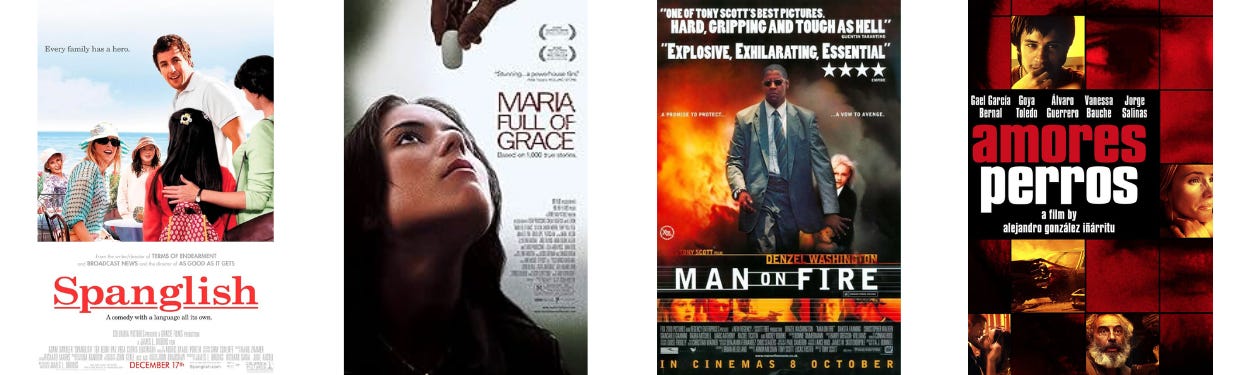
Spanglish (2004)
A comedy-drama film starring Adam Sandler and Paz Vega, exploring the cultural clash between an American family and their Spanish-speaking housekeeper.
Maria Full of Grace (2004)
A drama film about a Colombian teenager who becomes a drug mule, featuring dialogue in both Spanish and English.
Man on Fire (2004)
A thriller film starring Denzel Washington and Dakota Fanning, set in Mexico City and featuring Spanglish conversations.
Amores Perros (2000)
A critically acclaimed Mexican film directed by Alejandro González Iñárritu, featuring multiple storylines and Spanglish dialogue.
Y Tu Mamá También (2001)
A coming-of-age film from Mexico, following two teenage boys and an older woman on a road trip, featuring Spanglish dialogue.
Our Family Wedding (2010)
A romantic comedy about the cultural clashes that arise when an African-American family and a Mexican-American family come together for a wedding, featuring Spanglish conversations.
Nothing Like the Holidays (2008)
A family comedy-drama set during the Christmas season, exploring the dynamics of a Puerto Rican family in Chicago, with Spanglish dialogue.
Spanglish criticisms
Criticism of Spanglish primarily comes from linguistic purists, traditionalists, and language preservation advocates. Their concerns often revolve around the following points:
- Language purity
Some individuals argue for the preservation of pure, traditional forms of languages (such as Spanish and English) without any form of mixing. They believe that Spanglish dilutes the integrity of these languages. - Communication clarity
Critics express concerns that Spanglish terms may lead to misunderstandings, especially for those not familiar with the hybrid language. They worry that blending languages might complicate effective communication. - Educational challenges
Some critics argue that the use of Spanglish in educational settings could hinder language learning and literacy, especially among younger generations. They fear that students might struggle with proper grammar and vocabulary in both languages. - Social stigma
In certain contexts, Spanglish has faced social stigma, with some associating it with lower socioeconomic status or lack of education. This negative perception can lead to discrimination and prejudice against individuals who use Spanglish. - Preservation of cultural identity
Some critics fear that Spanglish could erode cultural identity by diluting the distinct linguistic and cultural features of Spanish-speaking communities. They worry that future generations might lose touch with their heritage languages and traditions. - Professional and academic environments
There are concerns that the use of Spanglish dialect in formal or professional contexts might not be deemed appropriate. Critics argue that maintaining a clear distinction between languages is crucial in professional and academic settings.
However, it's important to note that the criticism of Spanglish is not universally shared. Many linguists, scholars, and advocates for cultural diversity view Spanglish as a natural and creative evolution of language, reflecting the multicultural reality of many communities.
In my opinion, preserving a language while accepting its natural — an unavoidable evolution — is not incompatible.
A fiesta of diversity!
Our journey through the Spanglish dialect has been a maravillosa exploration of this unique linguistic landscape.
In a world where borders blur and cultures entwine, Spanglish is a fiesta of diversity, a puente between communities, and a lindo reminder that language, like life itself, is ever-evolving.
If you love the two media naranjas that form Spanglish, check out our Spanish blog and English blog.
Spanglish reminds us that communication knows no boundaries, and that understanding each other is the ultimate language of humanity. ¡Viva el Spanglish!
.jpg?auto=webp&format=pjpg&quality=80&width=800&height=800&fit=crop&crop=800:600,smart)